

You can eat
- More substantial breakfast and dinner: these are the times when the stimulant has not started working yet or has worn off [1].
- Protein with every meal: eggs, fish, chicken, meat, pulses, dairy products and nuts, ground or as a spread.
- Grains and starchy vegetables, preferably wholegrain: bread, rice, pasta, oats and potatoes.
- Pulses two or three times a week: protein, iron and fibre in the same dish.
- Whole fruit and vegetables at lunch and dinner, starting with the ones they already like.
- Milk, plain yoghurt and cheese: if they eat little, these provide calcium and energy with little effort.
- Iron with vitamin C: pulses, meat or fish with tomato, pepper or an orange for dessert.
- Olive oil, avocado, ground nuts and oily fish: plenty of energy in a small volume.
What to avoid
- Sweets, pastries and sugary soft drinks: they fill up a child who already eats little without nourishing them.
- Packaged juices and sugary drinks between meals: they take away their appetite just before eating.
- Caffeinated drinks such as cola, tea or energy drinks: they make sleep, which is already difficult, worse.
- Snacking in the half-hour before a meal: appetite is often low at lunchtime, and it is best not to reduce it further.
- Systematically removing the six colourings that must carry a warning on the label: E-102, E-104, E-110, E-122, E-124 and E-129 [2]. Their removal is not recommended as a general treatment for ADHD [1].
- Removing gluten or milk “to see what happens”: this has no demonstrated scientific basis for ADHD [3].
- “Concentration” supplements bought online: do not use them on your own.
- Replacing a meal with a shake or a bar: this takes away one of the few opportunities to eat well.
Changes that help
Breakfast
Instead of chocolate cereal, offer bread with oil and tomato or egg, milk or yoghurt, and fruit, because appetite is best before the medication starts working.
Afternoon snack
Instead of pastries after school, offer bread with cheese or tuna, yoghurt and fruit, because the medication’s effect wears off around then and appetite returns.
Drinks
Instead of packaged juice or a soft drink with a meal, offer water, because sugary drinks fill them up and leave less room for food.
Dinner
Instead of deciding what to make at the last minute, have dinner ready before their appetite returns, because a ten-minute wait can determine whether they eat.
Habits that help
- Eat with them at the same time every day: routine supports appetite more than any food.
- Keep screens away from the table: a distracted child stops eating as soon as they lose sight of the meal.
- Offer the food without negotiating: what is left on the plate is neither rewarded nor punished.
- Keep a fixed bedtime and switch off screens an hour beforehand.
Almost every family who comes to a consultation with an ADHD diagnosis has already changed something at home, usually by removing foods. This is understandable. Families are looking for something they can control, rather than relying only on the doctor.
Almost none of that list is supported. What you can do at home is make sure your child eats enough when the medication takes away their appetite, and that their weight and height continue to develop appropriately.
Is there a diet for ADHD?
No. ADHD is a neurodevelopmental disorder, which means it affects how the brain matures. No consensus guideline recognises a dietary treatment for it. The British NICE guideline recommends the same for these children as for any other child: a balanced diet, good nutrition and regular exercise [1].
Paediatric guidelines take the same approach. They place dietary changes among interventions with very little evidence or little to no benefit [4]. The approaches with strong support are approved medication and parent training in behaviour management, with the school included in the plan [4].
So diet is not part of the treatment. It does matter for supporting appetite and growth, because ADHD and its medication affect how a child eats.
Do colourings and sugar make ADHD worse?
There is some truth to this. Since July 2010, European regulations have required a warning on the label for six colourings [2]. These are tartrazine, quinoline yellow, sunset yellow, carmoisine, cochineal red A and Allura Red AC. The warning states that they “may have an adverse effect on activity and attention in children” [2]. It is a precaution that applies to the child population as a whole.
The exaggeration is to turn that warning into a diet. Guidelines say not to recommend removing colourings and additives as a general treatment for ADHD [1]. As for broad elimination diets, in which many foods are removed and then reintroduced, there is no evidence of long-term effectiveness or of their possible harms [1]. The benefit seen in the short term is limited [1].
If you think a particular food changes your child’s behaviour, record it in a food and behaviour diary [1]. If the diary confirms it, the next step is a referral to a dietitian-nutritionist to work on it together with the paediatrician [1]. Removing foods on your own leaves your child with fewer choices.
Sugar is similar. An analysis of seven observational studies found an association between sugar, sugary drinks and ADHD symptoms [5]. The authors themselves urge caution because the studies differed greatly from one another [5]. Association is not causation. Even so, it is a good idea to reduce sweets and soft drinks for a simple reason: they take away appetite just when it is needed.
Do omega-3, vitamins or amino acids help?
Not as a treatment for symptoms. The 2023 Cochrane review brought together 37 trials in children and adolescents with ADHD [6]. It concluded, with high certainty, that polyunsaturated fatty acids such as omega-3 do not improve overall symptoms, as assessed by parents, compared with placebo [6]. They did not improve inattention or hyperactivity either [6]. Guidelines advise against offering these supplements to treat ADHD [1]. If there is an indication for another reason, your doctor or dietitian-nutritionist should prescribe them.
The idea that amino acids “feed” neurotransmitters, such as tryptophan or tyrosine, is not supported by trials. A 2022 review found 14 trials on tryptophan in ADHD, and none gave it as a supplement [7]. They withdrew it for a few hours to study its role, and most did not measure the main symptoms [7].
Gluten-free or casein-free diets—casein is the protein in milk—are listed among therapies without demonstrated scientific basis [3]. Some of these therapies can also cause harm, such as megadoses of vitamins [3]. If a blood test shows low iron or vitamin D, it is corrected because it is low, as advised by the paediatrician.
What should I do if the medication takes away their appetite?
This is the part we deal with most often. Loss of appetite is the most common adverse effect of stimulants, alongside stomach ache, headache and sleep problems [4]. It occurs with methylphenidate, lisdexamfetamine and atomoxetine too [3]. Stomach aches and headaches during the first few days usually pass quickly [3]. If they also have difficulty going to the toilet, our constipation guide includes dietary advice for this.

Regarding growth, a long-term follow-up study found an adult height 1 to 2 cm below the predicted height [4]. This occurred mainly with high, sustained doses. The effect slowed around the third year of treatment, and there was no subsequent catch-up growth [4]. That is why growth is monitored closely.
When weight loss is a concern, the NICE guideline suggests six strategies [1]:
- Ask the prescriber whether it would be better to take the medication with or after food instead of before.
- Add meals or snacks early in the morning or later in the day, when the effect has worn off.
- Ask for dietary advice.
- Offer foods that are energy-dense and nutritionally good quality.
- Ask the prescriber whether a planned break from treatment would be appropriate.
- Ask the prescriber whether switching medication would be appropriate.
The first and last two decisions are made by the prescriber. Before changing the timing of doses, talk to them. The other three are within our remit. The idea is to make the most of the times when appetite returns and ensure there is good food available then.
For children taking medication, height is measured every 6 months, and weight every 3 months until age 10, using the growth chart [1]. In Spain, the paediatric protocol suggests a check-up one or two months after starting, and then every 6 months, including weight, height and blood pressure [3].
What mistakes do we see in consultations?
Three mistakes come up repeatedly in consultations, and none is due to a lack of trying.
- Insisting on lunch. This is when appetite is lowest. Fighting over that meal tires everyone, while a well-planned afternoon snack and dinner can make more of a difference.
- Removing several foods at once. Cutting out colourings, gluten and dairy in the same week leaves a child who already eats little with a short menu. It also tells you nothing about what was working.
- Filling hunger with grazing. Biscuits or juice late in the afternoon may seem helpful. They arrive just before dinner, when the child might otherwise be hungry.
If they only eat four or five things
This is common. Variety comes from putting a new food next to a familiar one, in a small amount, without commenting on it or requiring them to try it. It matters more that the food is offered many times than what happens on the first day.
It helps to offer the same food in different forms, because raw carrot sticks are not the same as carrot in a stew. It also helps to involve them in shopping and cooking, and to keep mealtimes separate from conversations about school.
If they eat fewer than ten or fifteen different foods and reject entire food groups, tell the paediatrician. This is one of the warning signs. Our guide to nutrition during school age provides general guidance for this age.
What a day can look like, meal by meal
There is no fixed weekly menu, because the schedule depends on which medication is taken and at what time. This outline places the main meals when appetite is present.
| Time | What to offer |
|---|---|
| Breakfast | The most substantial meal of the day if the medication is taken afterwards. Milk or yoghurt, bread with oil and tomato or with egg, and fruit |
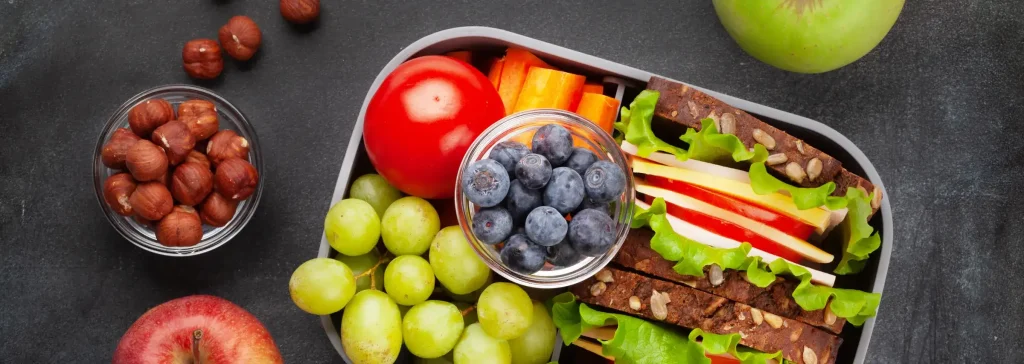
| School break | Something that can be eaten with one hand and without cutlery. A small sandwich, including one with nut butter, and a piece of fruit |
| Lunch | Usually the meal that goes down least well. One small dish combining vegetables, protein and grains or potatoes, rather than three large courses |
| Afternoon snack | An important meal, because the effect starts to wear off after school. Yoghurt, fruit, bread with cheese or tuna |
| Dinner | The second opportunity of the day. Egg, fish, pulses or chicken with vegetables and bread. If they are hungry at bedtime, a glass of milk or a piece of fruit |
For the school break and afternoon snack, how to prepare healthy school snacks for your children includes combinations we use in consultations. If they continue to eat little or lose weight with this outline, a paediatric dietitian working in coordination with the paediatrician may be able to help.
If they have stopped eating or have lost weight since starting medication, it makes sense to have someone review this with you. Our team of paediatric dietitians works in coordination with the paediatrician and child and adolescent mental health services, in Barcelona and online.
The aim is simple: for your child to have eaten by the end of the day, for their weight and height to continue along their growth curves, and for dinner to stop being a battle.
We explain it on video
Your first step this week
Write down their hunger times for three days
Note what time they take their medication and when they ask for food or enjoy eating. With those times in front of you, place the most substantial meal of the day then.
When to see a doctor
When to see a doctor
Through nutrition, we can support appetite, weight and growth in a child with ADHD, and help make mealtimes less conflictual. We cannot diagnose or treat ADHD. That is done by child and adolescent mental health services together with the paediatrician, and medication is prescribed and adjusted by the person who prescribed it.
Make a medical appointment without waiting to change the diet if you notice any of these signs:
- They are losing weight, or have not grown as expected for months [8]
- Their way of eating has changed suddenly: they skip meals, count calories, hide food or go to the bathroom as soon as they have finished eating [9]
- They eat fewer than ten or fifteen different foods and reject entire food groups
- They look pale, feel tired, have trouble concentrating or become short of breath while playing
A sudden change in eating habits should not wait and should not be monitored at home: see the paediatrician this week, with a referral to child and adolescent mental health services. For the other signs, see the paediatrician, who can refer to a paediatric dietitian if appropriate.
Almost all children go through phases of unusual eating, and these resolve on their own. The signs above are the ones that do call for a consultation.

Bring your questions about their meals to a first appointment with the family
At the first appointment, we talk about what your child eats and what concerns you, and you leave with the first recommendations. Bring the latest measurements from the paediatrician if you have them. The plan for the whole household comes a week later, in person or by video call.
Keep reading

Anti-inflammatory nutrition: what to eat and what to expect
You have been told to eat ‘anti-inflammatory’ foods, and what you find is superfoods, supplements and lists of…
School-age nutrition: what to eat from 6 to 12
Your child already eats at school and is making more choices about what they want to eat. Every…
Healthy school snacks for children: 7-day menu and shopping list
It is quarter to eight and you still need to pack something for break time. One shop can…
Healthy breakfasts for children: 7 ideas for the week
When you are rushed and tired and your child is not hungry at eight o'clock, breakfast almost always…
 Resource hub
Other conditions: diet and nutrition guides
Nutrition as part of your treatment
 Resource hub
School-age nutrition guides
Guides to planning meals for children aged 4 to 11, inside and outside school.
 Consultation
Paediatric registered dietitian in Barcelona and online
The habits we learn in childhood stay with us for life
Book a visit →




Sources
- National Institute for Health and Care Excellence. Attention deficit hyperactivity disorder: diagnosis and management. NICE guideline NG87. London: NICE; 2018 (updated en 2019). https://www.nice.org.uk/guidance/ng87
- Reglamento (CE) n.º 1333/2008 del Parlamento Europeo y del Consejo, de 16 de diciembre de 2008, sobre aditivos alimentarios. Anexo V. DOUE L 354, 31 de diciembre de 2008. https://eur-lex.europa.eu/legal-content/ES/TXT/?uri=CELEX:32008R1333
- Escofet Soteras C, Fernández Fernández MA, Torrents Fenoy C, et al. Trastorno por déficit de atención e hiperactividad (TDAH). Protoc diagn ter pediatr. Madrid: Asociación Española de Pediatría; 2022;1:85-92. https://static.aeped.es/09_2f84b18fdb.pdf
- Wolraich ML, Hagan JF, Allan C, et al. Clinical practice guideline for the diagnosis, evaluation, and treatment of attention-deficit/hyperactivity disorder in children and adolescents. Pediatrics. 2019;144(4):e20192528. doi:10.1542/peds.2019-2528
- Farsad-Naeimi A, Asjodi F, Omidian M, et al. Sugar consumption, sugar sweetened beverages and attention deficit hyperactivity disorder: a systematic review and meta-analysis. Complement Ther Med. 2020;53:102512. doi:10.1016/j.ctim.2020.102512
- Gillies D, Leach MJ, Perez Algorta G. Polyunsaturated fatty acids (PUFA) for attention deficit hyperactivity disorder (ADHD) in children and adolescents. Cochrane Database Syst Rev. 2023;4(4):CD007986. doi:10.1002/14651858.CD007986.pub3
- Dinu LM, Phattharakulnij N, Dommett EJ. Tryptophan modulation in individuals with attention deficit hyperactivity disorder: a systematic review. J Neural Transm (Vienna). 2022;129(4):361-377. doi:10.1007/s00702-022-02478-5
- National Institute for Health and Care Excellence. Faltering growth: recognition and management of faltering growth in children. NICE guideline NG75. London: NICE; 2017. https://www.nice.org.uk/guidance/ng75
- National Institute for Health and Care Excellence. Eating disorders: recognition and treatment. NICE guideline NG69. London: NICE; 2017 (updated en 2020). https://www.nice.org.uk/guidance/ng69
Written and reviewed by


How we can help
Now, applied to you
Paediatric registered dietitian in Barcelona and onlineThe habits we learn in childhood stay with us for life
4.9 on Google · 5.0 on Doctoralia · 2,047 reviews
