

Habits that help
- Eat at the table, without screens and slowly, to give fullness signals time to register.
- Serve the vegetables so they fill half the plate, and divide the rest equally between protein and grains or potatoes.
- Keep water close by during the day; drinking when you are thirsty can help you avoid habitual snacking.
- Look after your sleep, because sleeping too little is associated with greater appetite and a preference for higher-calorie foods.
If you have tried to lose weight by eating less and less, you know how it ends: hunger in the afternoon, meals you do not fancy and giving up before Friday.
This menu offers meals full of vegetables and pulses, in filling portions. Several dishes are cooked once and eaten over two days, so the week does not depend on having time every afternoon.
Who is this low-calorie menu for, and who is it not for?
It is designed for a healthy adult who wants to lose fat without going hungry and learn how to put together balanced meals. The underlying guidance is in our guide to losing fat and keeping it off.
It has not been calculated for people with diabetes treated with medication or insulin, moderate or advanced kidney disease, people who are pregnant or breastfeeding, or older people who are frail. In these cases, a dietitian-nutritionist should plan your diet together with your medical team.
If you have or have had an eating disorder, the first step is specialist psychological support, before following any menu. And if you are already at a low weight or want to gain weight, see our weight-gain nutrition service.
The full week: breakfast, lunch and dinner
| Day | Breakfast | Lunch | Dinner |
|---|---|---|---|
| Monday | Wholegrain rolled oats with plain unsweetened yoghurt, chia seeds and slices of fresh kiwi | Wholegrain pasta salad (40 g uncooked) with cooked green beans, roasted pepper, 200 g of drained cooked chickpeas and fresh cheese · one apple | Sea bream fillet (150 g) marinated with lime, ginger and soy sauce, grilled with wild asparagus and wholegrain pasta (40 g uncooked) · plain yoghurt |
| Tuesday | 100% wholegrain toast with grated tomato and extra virgin olive oil · one pear · black coffee or herbal tea | Hake (150 g) stewed in a casserole with softened onion, tender peas and reduced white wine sauce, with brown rice (40 g uncooked) · one orange | Mild homemade gazpacho without bread with sliced mushrooms and diced fresh turkey breast (150 g), served with brown rice (40 g uncooked) · herbal tea |
| Wednesday | Plain yoghurt with a chopped apple, ground cinnamon and two tablespoons of rye or oat flakes | Sautéed cooked white beans (200 g drained) with courgette, onion cut into strips, a touch of curry and low-salt soy sauce · one pear | Grilled chicken breast (150 g) with lemon juice, served with tomato, cucumber and oregano salad, with wholegrain couscous (40 g uncooked) · a slice of melon |
| Thursday | Wholegrain bread with whole or semi-skimmed fresh cheese and homemade unsweetened compote made from one apple · coffee with whole or semi-skimmed milk or unsweetened plant-based drink | Warm salad of cooked lentils (200 g drained) with fresh spinach, cherry tomatoes, red onion, a slice of diced melon and a lemon juice and mint dressing · herbal tea | Mild courgette and leek soup without cream, with two poached eggs, sesame seeds and wholegrain pasta (40 g uncooked) · herbal tea |
| Friday | Rolled oats soaked overnight in whole or semi-skimmed milk, or a plant-based drink, with cinnamon and a sliced banana | Sautéed brown rice (40 g uncooked) with green beans, diced carrot and strips of grilled fresh turkey breast (150 g) · one mandarin | Sautéed vegetables (courgette and onion prepared in advance) with a two-egg French omelette and brown rice (40 g uncooked) · unsweetened compote made from one pear |
| Saturday | Wholegrain toast with whole or semi-skimmed whipped fresh cheese, radish slices and a pinch of oregano · green tea or coffee | Oven-baked salmon fillet (150 g) with a small baked potato and lamb’s lettuce salad with radishes and apple cider vinegar · one kiwi | Wok-fried al dente broccoli, red pepper and carrot with sautéed diced chicken (150 g), wholegrain pasta (40 g uncooked) and sunflower seeds · a slice of fresh pineapple |
| Sunday | Bowl of plain yoghurt with 3 chopped walnuts and an orange cut into segments | Sautéed cooked chickpeas (200 g drained) with spinach, chopped garlic, sweet paprika from La Vera · one kiwi | Carrot soup with a full salad of leafy greens, cucumber, one boiled egg and tuna in spring water (150 g drained), with brown rice (40 g uncooked) · herbal tea |
The table gives guideline quantities for one adult, without calculating calories. Your needs depend on your muscle mass, height, age and daily activity. In consultations we adjust these portions to each person. If you want to adjust the energy in your meals without reducing their volume, see our guide to reducing calories without going hungry.
All lunches and dinners include vegetables, protein and carbohydrates. Fruit is spread over two or three servings a day; a compote contains one whole piece of fruit, with no added sugar. Also have two or three plain or toasted walnuts a day; on Sunday they are in the breakfast.
Weekly shopping list
The quantities are guidelines, for one adult and seven days. The quantities of cereals, pulses, fish, meat and eggs are what you will use, not the size of the pack. To cook each lunch or dinner as a single dish, use 1 to 1.5 tablespoons of oil. If there is a first and a second course, use one dessert spoon on each plate. Check your pantry before you go and cross off anything you already have. If you replace milk with a soy drink, remember that soy is one of the allergens that must be declared.
Vegetables
- 3 medium courgettes
- 1 kg sweet or red onions
- 2 leeks
- 1 bag of 300 g fresh spinach
- 2 bags of 150 g mixed leafy greens (lamb’s lettuce, lettuce)
- 1 kg tomatoes for Tuesday’s toast, Wednesday’s salad and Tuesday’s gazpacho
- 1 punnet of 250 g cherry tomatoes
- 2 cucumbers
- 3 red and green peppers
- 500 g fresh or frozen green beans
- 500 g carrots
- 1 broccoli, about 500 g
- 1 tray of 250 g button mushrooms
- 1 bunch of wild asparagus
- 1 bunch of radishes
- 1 head of garlic
- 1 small piece of fresh ginger
- 1 bunch of fresh mint
Fruit
- 3 kiwis
- 3 apples (Monday, Wednesday and Thursday’s compote)
- 3 pears (Tuesday, Wednesday and Friday’s compote)
- 2 oranges and 1 mandarin
- 2 slices of melon (Wednesday and Thursday); buy the cut that contains them
- 1 slice of fresh pineapple (Saturday); buy a cut or keep the leftover
- 1 banana for Friday’s breakfast
- 3 lemons
- 2 limes
Pulses, grains and starchy vegetables
- 200 g cooked white beans, drained weight (one portion)
- 200 g cooked lentils, drained weight (one portion)
- 400 g cooked chickpeas, drained weight (two portions of 200 g)
- 40 g wholegrain couscous, uncooked, for Wednesday; keep the dry remainder of the pack
- 200 g tender peas, fresh or frozen
- 160 g wholegrain pasta, uncooked (four servings of 40 g); keep the dry remainder of the pack
- 160 g brown rice, uncooked (four servings of 40 g); keep the dry remainder of the pack
- 500 g wholegrain rolled oats (shop pack size; three breakfasts, with dry remainder)
- 1 loaf or 1 tin loaf of 100% wholegrain bread for three breakfasts; freeze the leftover slices
- 1 small potato for Saturday
Fish, meat and eggs
- 1 fresh or frozen hake fillet of 150 g
- 1 cleaned sea bream fillet of 150 g
- 1 fresh salmon fillet, about 150 g
- Tuna in spring water: enough tins for 150 g drained weight (check the label)
- 300 g sliced chicken breast (two portions of 150 g)
- 300 g fresh turkey breast in fillets or cubes (two portions of 150 g; not cold cuts)
- 5 eggs (two on Thursday, two on Friday and one on Sunday)
Dairy and drinks
- 4 plain unsweetened yoghurts, whole or semi-skimmed (two on Monday, one on Wednesday and one on Sunday)
- 2 tubs of 250 g whole or semi-skimmed fresh cheese; one can be whipped fresh cheese (three servings, with leftover).
- 1 litre of whole or semi-skimmed milk, or unsweetened plant-based drink with at least 3% protein (two servings, with leftover).
Pantry
- Extra virgin olive oil: 14 to 21 tablespoons for the 14 lunches and dinners as single dishes, plus Tuesday’s breakfast
- Apple cider or sherry vinegar
- White wine for cooking
- Low-salt soy sauce
- Curry, sweet paprika, oregano, cinnamon and black pepper
- Chia, sesame and sunflower seeds
- 21 plain or toasted walnuts (three a day, including Sunday’s); buy a pack that contains them
- Assorted herbal teas (green tea, chamomile, pennyroyal mint)
How to prepare the week’s meals ahead
On Sunday, prepare the bases for Monday and Tuesday. Freeze cooked dishes that you will not eat within two days. Cook the rice on the day of each meal and leave Thursday’s compote for the day before.
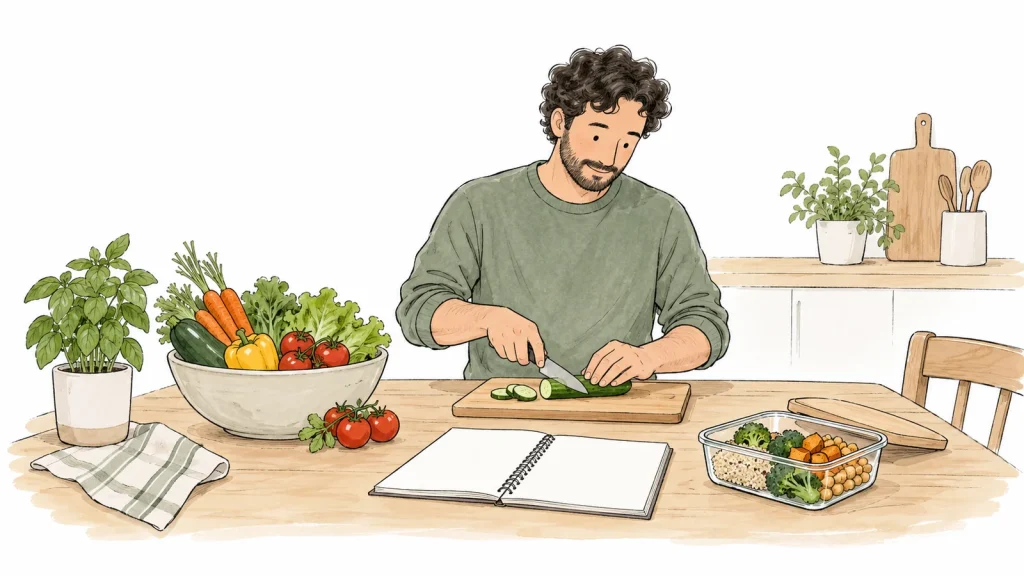
- Cook several things at once. Cook the wholegrain pasta and Monday’s green beans. Keep the cooked pasta covered in the fridge and eat it within 24 hours. Prepare the other cereals on the day of each meal. Roast the peppers if you want to prepare that base ahead.
- Hake stew. Soften chopped onion with the indicated amount of olive oil in a wide pan. Add the hake, peas and a splash of white wine, and let it reduce for 10 minutes over a medium heat. If you make it on Sunday for Tuesday, freeze it once cool and thaw it in the fridge the day before.
- Vegetable stir-fry for two days. Sauté plenty of diced courgette and onion in a large frying pan. When they are al dente, add a teaspoon of curry and low-salt soy sauce. Mix half with the 200 g of drained beans and freeze it for Wednesday. Also freeze Friday’s half. Thaw each portion in the fridge the day before.
- Marinade and cold bases. Marinate and cook the sea bream on Monday. Make the gazpacho on Monday for Tuesday and keep it covered in the fridge. Prepare the compote on Wednesday for Thursday’s breakfast and soak the oats on Thursday night, in the fridge.
- Cool quickly. Do not leave cooked food at room temperature for hours. Divide it among small containers and, to cool it faster, place them sealed in an ice-water bath before putting them in the fridge. Keep cooked dishes covered for a maximum of two days; rice and other cooked cereals, 24 hours. Put the rice in the fridge within an hour and reheat it thoroughly only once. To take it with you, keep it cold in the fridge or in an insulated bag with an ice pack. Freeze any dishes suitable for freezing that you need to keep for longer.
What helps meals keep you full
It is based on four ideas, and none of them requires you to count calories.
The first is low energy density. Vegetables, pulses, whole fruit, soups and gazpacho provide plenty of volume and water with little energy per bite. When meals have a lower energy density, people eat a similar amount of food with fewer calories, without feeling hungrier [1].
Eating fewer calories does not mean having to eat less food.
The second is fibre. With pulses, wholegrains, whole fruit and vegetables at lunch and dinner, the menu aims to come close to 25 g of fibre a day [2]. The European Food Safety Authority considers this amount adequate for bowel function in adults. The menu figure is an estimate based on food groups, not a calculation using software; a high-fibre dish also takes longer to eat.
The third is protein at every main meal, from fish, poultry, eggs, pulses or dairy products. Eating a little more protein is more filling and helps preserve muscle while you lose weight [3]. Over the long term, being able to maintain the eating plan matters more, which is why the dishes are simple and can be repeated [3].
The fourth is that it leaves out free sugars. It contains no soft drinks, pastries or sugary desserts, and the fruit is whole rather than juiced. This is the simplest way to stay below the recommended limit of less than 10% of daily energy intake [4].
How low should you go with calories?
Not as low as people often think. Weight loss involves working on food, physical activity and psychological support at the same time [5], and this menu covers only the food part.
The UK obesity guideline reserves plans of less than 1,200 kcal a day for specialist programmes with clinical follow-up [6]. We do not recommend them in consultations either, except when specifically indicated by a doctor. That is why this menu does not set a calorie figure and instead suggests lower-calorie dishes.
What mistakes do we see in consultations?
Drinking calories without realising it. Soft drinks and packaged juices add calories but do little to satisfy hunger. There is no safe amount of alcohol for health (WHO): the less, the better, and none during pregnancy, breastfeeding or childhood, before driving, or if your medication does not allow it. In consultations, we review drinks before looking at any particular dish.
Taking care with the plate but forgetting what goes with it. Fatty cured meat, a shop-bought cream sauce, battered food or a handful of crisps add a lot of energy in a small volume [1]. Replace the sauce with a dressing made from plain yoghurt, lemon, herbs or vinaigrette, and replace fried food with grilled, baked or steamed food.
Giving up on the week because one dish does not appeal. Swap just that dish for another breakfast, lunch or dinner from the table and carry on. For the evening, you will find more options in 7 low-calorie dinners.
A menu written for everyone does not know your schedule, your tastes or how each dish suits you. It is useful for getting started and seeing that you can eat well without going hungry.
If you want a plan made for you, taking your body composition and pace into account, our weight-loss nutrition team can prepare it with you, without crash diets or unnecessary supplements. We see patients in Barcelona and online.
Changes that help
If you do not eat meat or fish
Instead of chicken, turkey or fish, use tofu, tempeh, textured soy, eggs or an extra serving of pulses, because these still provide protein at every main meal.
If you bring lunch to work
Instead of grilled dishes, try complete pulse salads or stir-fries with brown rice, because they hold their texture better when reheated or eaten warm.
If gazpacho does not agree with you
Instead of gazpacho, have a chilled soup made from cooked courgette with yoghurt and mint, or gazpacho without cucumber or raw garlic, because cooked vegetables are often better tolerated.
If pulses give you gas
Instead of whole pulses, try peeled red lentils or well-rinsed tinned pulses, because rinsing removes some of the carbohydrates that ferment and produce gas.
Your first step this week
Keep an emergency dinner in the pantry
Before Monday, buy a jar of cooked chickpeas and two tins of tuna in spring water. On a night when you get home late, add a tomato and olive oil for dinner in five minutes.

Your week of meals, ready for the fridge
- 7-day menu with the shopping list
- 8 recipes: cook once, eat twice
- What to do when the week goes off track
Where should we send it?
Free PDF, in your inbox in a moment.
Data controller: Alimmenta Tu Vida, S.L. Purpose: to send you the guide and, only if you tick the second box, tips by email on the topic. You can withdraw your consent and exercise your rights at [email protected]. Legal basis, recipients and retention periods are in our privacy policy.
When to see a doctor
This menu is a general suggestion for healthy adults. It is not an individualised eating plan and does not replace a nutrition consultation or medical treatment.
If you notice this sign while following the menu, do not wait to change your diet:
- You faint while following a very low-calorie diet [5].
If you faint, seek urgent care today.
The full list of signs that call for a medical appointment is in the guide to losing fat and keeping it off.

Every case is different
General guidance can only take you so far. The next step is to look at your situation in a consultation.
Keep reading

Weight-loss diet: how to lose fat and keep it off
You have tried diets that worked for a month, only for the weight to come back, and now…

7 low-calorie dinners: your week and shopping sorted
By dinner time there is little appetite for cooking, and it is easy to end up eating the…
How to reduce calories without going hungry: what to eat and how
You eat less, go hungry and give up after a few weeks. This is the most common outcome,…
Low-calorie packed lunches: 6 filling meals to take to work
You bring lunch to work, but by five o’clock you are already looking for something in the office…
Healthy weekly meal plan for the whole family: 7 days and a shopping list
Between work, school and everyone’s tastes, the week usually ends up with improvised meals or two different menus…
How to prepare a menu to lose weight: 7 days and shopping list
You know what you should eat, but you get home at nine hungry, with a half-empty fridge and…

How we work: first visit, eating plan and follow-up


Sources
- Rolls BJ. Dietary energy density: applying behavioural science to weight management. Nutr Bull. 2017;42(3):246-253. doi:10.1111/nbu.12280
- EFSA Panel on Dietetic Products, Nutrition and Allergies (NDA). Scientific Opinion on Dietary Reference Values for carbohydrates and dietary fibre. EFSA J. 2010;8(3):1462. doi:10.2903/j.efsa.2010.1462
- Magkos F. The role of dietary protein in obesity. Rev Endocr Metab Disord. 2020;21(3):329-340. doi:10.1007/s11154-020-09576-3
- Organización Mundial de la Salud. Guideline: sugars intake for adults and children. Geneva: OMS; 2015. https://www.who.int/publications/i/item/9789241549028
- Sociedad Española para el Estudio de la Obesidad (SEEDO). Guía española del manejo integral y multidisciplinar de la obesidad en personas adultas (Guía GIRO). Madrid: SEEDO; 2024. https://www.seedo.es/images/images/site/SEEDO_Gua_GIRO_final_v12_16072024.pdf
- National Institute for Health and Care Excellence (NICE). Overweight and obesity management (NG246). London: NICE; 2025. https://www.nice.org.uk/guidance/ng246
Written and reviewed by


How we can help
Now, applied to you
How we work: first visit, eating plan and follow-up4.9 on Google · 5.0 on Doctoralia · 2,047 reviews
