

You can eat
- Pardina, Castilian, beluga or red lentils; red lentils, without their skins, cook in about 20 minutes without soaking.
- Cooked chickpeas in salads, purées or homemade hummus.
- White, pinto or black beans in stews, salads or blended into a purée.
- Fresh or frozen peas and broad beans as vegetables in stir-fries and mixed vegetable dishes.
- Soybeans and simple soy products: tofu, tempeh, edamame and textured soy.
- Cooked legumes in glass jars, rinsed well before use.
- Chickpea flour for omelettes, coatings or gluten-free doughs.
- Raw or unsalted roasted peanuts, and peanut butter made from peanuts alone.
- Canned lupin beans, rinsed, as a snack.
What to avoid
- Stews with chorizo, black pudding or bacon as a weekly habit; save them for special occasions.
- Canned legumes with their packing liquid, without rinsing.
- Ultra-processed vegetarian burgers, sausages and deli-style products high in salt and refined flour.
- Sweetened soy drinks, shakes and desserts.
- Fried, salted peanuts and peanut butter with added sugar or oils.
- Bagged fried and salted chickpeas and broad beans as a regular snack.
- Lupin beans in brine eaten daily without rinsing.
Changes that help
Legume stew
Instead of stew with chorizo or black pudding, try legumes with vegetables, paprika and a drizzle of olive oil. You keep the flavour while reducing saturated fat and salt.
Snack
Instead of fried, salted nuts, try cooked chickpeas roasted with spices. You add protein and fibre with less salt.
Minced meat
Instead of meat bolognese, use cooked lentils or textured soy. They provide protein and fibre and fit into a vegetarian diet.
Whole legumes that feel heavy
Instead of giving them up, try red lentils or a purée passed through a food mill; without their skins, they are often easier to digest.
Habits that help
- Eat slowly and chew well, especially when eating whole legumes.
- After eating, take a short walk; moving helps gas pass sooner.
- Cook a large batch at the weekend and freeze it in portions so you have some ready to use.
Legumes are among the most nutritious and affordable foods in the cupboard, yet in many homes they only appear in Sunday stew. We hear it often in consultations: “I like them, but then I spend the afternoon feeling bloated.” Almost always, a few kitchen adjustments can help, without giving them up.
What do legumes provide, and how do they differ?
Legumes are the seeds of leguminous plants. The most common ones, lentils, chickpeas and beans, are sold dried. They all share a similar nutritional profile. They contain complex carbohydrates, mainly starch, plenty of plant protein, lots of fibre and little fat, except for soybeans and peanuts. They also provide iron, zinc, magnesium, potassium and folate. See “Edamame”.
These are approximate figures per 100 g of raw product, according to the Spanish Food Composition Database (BEDCA) [1].
- Lentils. Around 24 g of protein and between 11 and 13 g of fibre [1]. Red lentils are sold without their skins, cook in about 20 minutes and are often easier to tolerate for people with digestive discomfort.
- Chickpeas. Around 19–20 g of protein and slightly more fat than lentils and beans, about 5 g [1].
- Dried beans. Around 21–22 g of protein and close to 20 g of fibre, making them one of the highest-fibre legumes [1].
- Soybeans. Around 35 g of protein and 18 g of fat, mostly unsaturated, with about 15 g of fibre [1].
- Peas and fresh broad beans. They contain much more water, so their protein content falls to around 5–6 g per 100 g [1]. In cooking, they work like a vegetable.
- Peanuts. Botanically, they are legumes. With close to half their weight made up of fat [1], they are used and eaten like nuts.
Lupin beans are among the legumes with the highest protein content. At home, they are mainly eaten from a jar as a snack.
The iron in legumes is non-haem iron and is absorbed less well than the iron in meat. Eating it alongside foods rich in vitamin C improves its absorption [3]. For example, lentil stew with peppers, chickpea salad with tomatoes, or an orange for dessert.
When cooked, legumes absorb water and increase in weight by about two and a half times. That is why 100 g of cooked lentils or chickpeas provide around 7–9 g of protein and 16–19 g of carbohydrates [1].
How many legumes should you eat a week?
The Spanish Agency for Food Safety and Nutrition (AESAN) recommends eating legumes at least four times a week, working towards daily consumption [2]. A serving is 50–60 g dried, a standard individual portion [2]. Once cooked, that is around 125–150 g of legumes, or a generous ladleful.
The agency also suggests eating more legumes to reduce animal protein intake [2]. If you follow a vegetarian diet, legumes become your main source of protein, and it is a good idea to include them almost every day. To fit them into your overall diet, see our guide on how to plan a vegetarian or vegan diet.
Is the protein in legumes complete? Do you need to combine them with grains?
Legume protein is good quality. With the exception of soy protein, it is a little low in methionine, an essential amino acid that the body cannot make. Grains have the opposite issue: they are low in lysine, which legumes contain in abundance. Together, they complement each other.
The idea that you have to eat them in the same meal is no longer supported. The Academy of Nutrition and Dietetics, the US association of dietitian-nutritionists, makes this clear in its position paper on vegetarian diets [3]. Protein from a variety of plant foods eaten throughout the day provides all the essential amino acids, as long as you eat enough energy [3]. Lentils at lunch and wholemeal bread at dinner work just as well as lentils with rice. See “Pescatarian diet”.
How can you digest legumes more easily and avoid gas?
Gas is mainly caused by sugars in legumes called galactooligosaccharides, such as raffinose and stachyose. The small intestine cannot digest them, so bacteria in the colon ferment them. This is normal, and there is a lot you can do in the kitchen. AESAN recommends soaking legumes, changing the water, cooking them for longer and increasing your intake gradually [2].
- Soaking. Leave dried legumes to soak in water for 8 to 12 hours, discard the water and cook them in fresh water. Some of these sugars pass into the soaking water.
- Cook them thoroughly. Legumes should be completely tender, and a pressure cooker cuts the cooking time considerably. Never eat dried legumes raw. Raw or undercooked beans contain lectins that can cause vomiting and diarrhoea.
- Without skins. Red lentils, split peas or a purée passed through a food mill are often better tolerated than whole legumes.
- Rinse canned legumes. Tinned legumes are already cooked. Drain and rinse them to remove the packing liquid, which contains salt and some of these sugars.
What health benefits do legumes have?
A review of 28 studies that followed people over several years compared those who ate more legumes with those who ate fewer [4]. The former had around 8–10% less cardiovascular disease and coronary heart disease, and 9% less hypertension [4]. No association with diabetes was found [4].

These are observational studies, and their authors rate the certainty of these conclusions as low or very low [4]. They show an association and do not, on their own, prove that legumes are the cause.
What mistakes do we see in consultations?
Three common stumbling blocks come up again and again, and none of them is the legumes’ fault.
- Cutting them out completely because of gas. If you have not eaten them for months and then go back to a full plate, you will notice it. Start with half portions and gradually increase them over a few weeks. Your gut gets used to them.
- Avoiding them because they “make you gain weight”. They provide volume, fibre and protein, which help you feel full. What usually adds energy to the dish is what goes with them, such as chorizo, black pudding or bacon in a stew.
- Comparing a jar with a packet. The label on the jar refers to cooked legumes, which have already absorbed water, while the packet label refers to dried legumes. That is why the jar may seem less nutritious, when the difference is the serving weight.
Ideas beyond stews
Stews are less appealing in summer, which is exactly when people tend to stop eating legumes. Here are a few ideas we use in consultations.
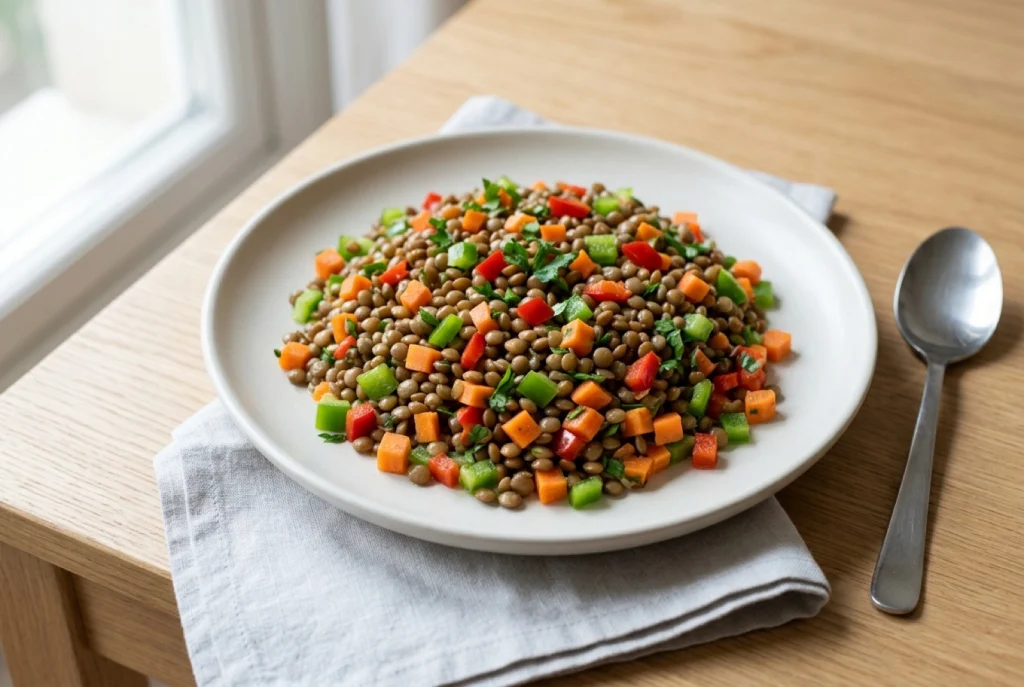
- Salads. Cooked chickpeas or lentils with tomatoes, cucumber, onion and extra virgin olive oil.
- Purées and spreads. Chickpea, white bean or red lentil hummus, served with carrot sticks or on toast.
- Homemade burgers. Cooked legumes blended with grated vegetables and rolled oats, then pan-fried.
- Stir-fries. Peas, fresh broad beans or edamame with vegetables and egg, or tofu.
- Chickpea flour. For an egg-free omelette or for coating food before frying.
If you would like to see them spread across a real week, take a look at our weekly ovo-lacto-vegetarian menu.
When should you take care?
- Irritable bowel syndrome. The galactooligosaccharides in legumes are FODMAPs. In people with irritable bowel syndrome, they can cause pain and bloating. If this applies to you, do not cut them out on your own. The FODMAP diet explains how it is managed, always after a medical diagnosis.
- Allergies. Peanuts are one of the most common food allergens. Soy and lupin are also allergens that must be declared on food labels. People with a peanut allergy may also react to lupin, so ask your allergist before trying it.
- Young children. Ask your paediatrician how and when to introduce peanuts. Do not give whole peanuts to children under five because of the risk of choking; smooth peanut butter or ground peanuts can be offered from the start of complementary feeding.
- Favism. People with glucose-6-phosphate dehydrogenase (G6PD) deficiency, an inherited red blood cell disorder, should not eat broad beans. If you have been diagnosed with it, follow your doctor’s advice.
Legumes do not need complicated recipes. Soaking, thorough cooking and a little imagination take them beyond stews and bring them into your weekly meals.
If you find it hard to include them or they do not agree with you, our team of dietitians specialising in vegetarian and vegan eating can help you plan meals, in Barcelona or online. We can also help if you follow a vegetarian diet and want to make sure you are getting everything you need.
Everyone tolerates legumes differently, and the best approach is the one that works for you.
Your first step this week
Always keep a jar in your cupboard
Buy a jar of cooked chickpeas or lentils this week. Once rinsed, they turn a salad or stir-fry into a complete meal in five minutes.
When to see a doctor
When to see a doctor
This guide explains what legumes provide and how to eat them; it does not replace an individual assessment. If you have a digestive condition, a diagnosed allergy or favism, follow your doctor’s advice first.
If you follow a vegetarian or vegan diet, legumes provide much of your protein, but B12 is essential and cannot be obtained from seaweed, yeast or fermented foods. The signs that mean you should see a doctor are covered in our guide on how to plan a vegetarian or vegan diet.

Start with a first appointment and make sure nothing is missing
Tell us how you eat now and what concerns you. We will tell you whether this consultation can help you now, with whom and in which format —in person or online—, and you can decide without pressure.---
Keep reading

Vegetarian and vegan diets: how to plan them well
You have given up meat, or are about to, and everyone asks where you get your protein. Sometimes…
Balanced weekly ovo-lacto vegetarian menu
Eating ovo-lacto vegetarian does not have to mean repeating pasta with cheese or spending all Sunday in the…
 Consultation
Vegetarian, vegan and flexitarian dietitian in Barcelona and online
A balanced vegetarian, vegan or flexitarian diet that fits your lifestyle
Book a visit →


Recipes for this goal


Sources
- BEDCA Network; Spanish Agency for Food Safety and Nutrition (AESAN). Base de Datos Española de Composición de Alimentos (BEDCA). Madrid: AESAN. Available at: https://www.bedca.net
- López García E, Bretón Lesmes I, Díaz Perales A, et al. Report of the Scientific Committee of the Spanish Agency for Food Safety and Nutrition (AESAN) on sustainable dietary recommendations and physical activity recommendations for the Spanish population. Revista del Comité Científico de la AESAN. 2022;(36):11-70. Available at: https://dialnet.unirioja.es/servlet/articulo?codigo=8783742
- Melina V, Craig W, Levin S. Position of the Academy of Nutrition and Dietetics: Vegetarian Diets. J Acad Nutr Diet. 2016;116(12):1970-80. doi:10.1016/j.jand.2016.09.025
- Viguiliouk E, Glenn AJ, Nishi SK, et al. Associations between Dietary Pulses Alone or with Other Legumes and Cardiometabolic Disease Outcomes: An Umbrella Review and Updated Systematic Review and Meta-analysis of Prospective Cohort Studies. Adv Nutr. 2019;10(Suppl 4):S308-S319. doi:10.1093/advances/nmz113
Written and reviewed by


How we can help
Now, applied to you
Vegetarian, vegan and flexitarian dietitian in Barcelona and onlineA balanced vegetarian, vegan or flexitarian diet that fits your lifestyle
4.9 on Google · 5.0 on Doctoralia · 2,072 reviews
