You can eat
- Turkey, chicken and lean cold meats, such as cooked ham or turkey. At least three servings of fish a week, favouring oily fish if it sits well with you.
- Up to four eggs a week as a reference, as a French omelette, poached or hard-boiled. Up to one egg a day can fit into a healthy diet.
- Up to three servings a day of semi-skimmed milk, plain yoghurt or low-fat fresh cheese, preferably unsweetened.
- Rice, pasta, bread and potato.
- Cooked, baked or puréed vegetables.
- Ripe whole fruit; also baked or as compote, which loses acidity.
- Olive oil, for cooking and for dressing.
- Water and mild broths.
- Mild infusions, such as camomile, lemon balm or lemon verbena.
- Boiling, steaming, baking and en papillote.
What to avoid
- Fried and battered food, fatty cured meats, offal and fatty meats. Also cream sauces, pastries and chocolate.
- Whole milk and mature cheeses.
- Tomato, vinegar, citrus fruit and unripe fruit, especially at dinner.
- Alcohol and fizzy drinks, from the first day.
- Coffee: avoid it. Tea: stop it for a week or two and try it again according to your tolerance.
- Mint infusions.
- Raw garlic, onion and pepper.
- Spicy food, pickles and very salty foods.
- Very cold or very hot meals.
- Charred food from the griddle.
Changes that help
Meat
Instead of fatty cold cuts and fatty meats, turkey, chicken, rabbit or white fish, because fat slows stomach emptying and gives reflux more time.
How you cook
Instead of fried and battered food and cream sauces, baking, steaming or cooking en papillote with a drizzle of olive oil, because that way the food contains less fat.
Dinner
Instead of tomato, vinegar or citrus in the evening, move them to lunchtime and have ripe fruit at dinner, because there is no need to cut them out, just to change when you have them.
Garlic and onion
Instead of raw garlic and onion, sweated over low heat, because they are usually better tolerated and still add flavour.
Habits that help
- Do not lie down until two to three hours after dinner, and not on the sofa either.
- Raise the head of the bed by about 10 cm if you have symptoms at night, with bed risers under the legs or a wedge.
- If you smoke, get help to stop.
- Wear loose clothing, with nothing tight around the waist.
- To pick something up from the floor, bend your knees, not your waist.
People who notice a hiatus hernia usually have acidity, discomfort in the pit of the stomach, a dry cough, bad breath or a feeling that food gets stuck. Over time they eat less and less, because eating becomes an ordeal.
This guide is about food and habits, and its scope is clear. The hernia is not corrected by eating differently. What can be reduced is the reflux that goes with it, which is what produces the symptoms.
What is a hiatus hernia and why does it cause heartburn?
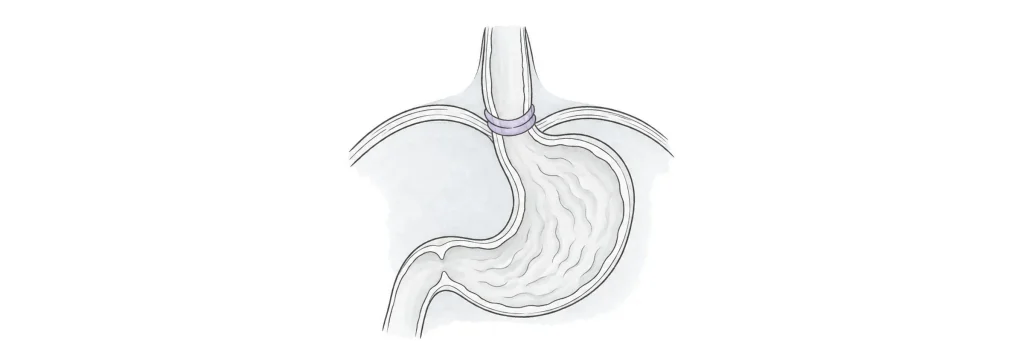
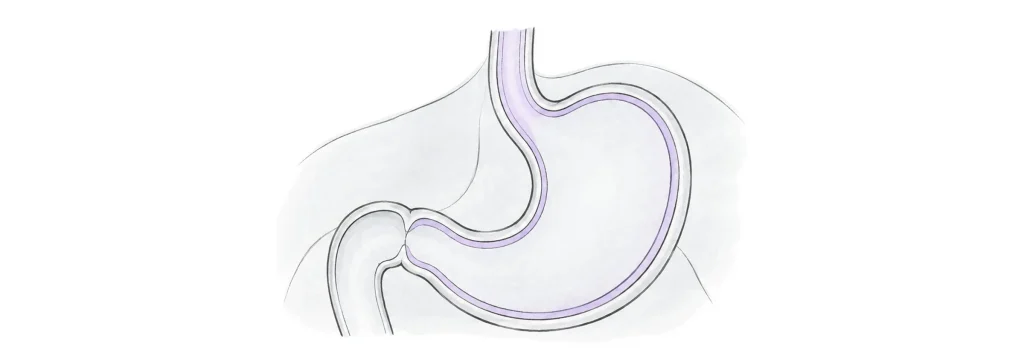
When we eat, food goes down the oesophagus, in the chest, to the stomach, in the abdomen. Between the two lies the diaphragm, and the oesophagus passes through it by an opening called the hiatus.
In a hiatus hernia, part of the stomach rises through that opening. The junction between the oesophagus and the stomach closes less well, and what is in the stomach comes back up more easily. That is gastro-oesophageal reflux.
The oesophagus is not designed to withstand digestive acid. It becomes irritated, and heartburn, pain behind the sternum and a dry cough appear. That is why the size of the hernia matters less than it seems. What determines how you feel is how much reflux there is and how long the acid stays up there. See “Heartburn in pregnancy”.
Why do I have a hiatus hernia?
There is almost never a single cause. It is associated with excess weight, smoking, strong coughing or repeated vomiting over a long time, and weakening of the diaphragm with age. It is common and often causes no symptoms. Endoscopy finds many more hernias than cause discomfort.
None of this is your fault. From that list there are two factors you can act on: weight and smoking. The American reflux guideline recommends acting on both [1].
Is a hiatus hernia the same as reflux?
No. A hernia promotes reflux and the two often go together. But reflux also occurs without a hernia when pressure inside the abdomen increases, as with excess weight or in pregnancy.
The symptoms are the same (heartburn, dry cough, discomfort) and this advice works equally in both cases. If yours is reflux without a hernia, there is the diet for gastro-oesophageal reflux.
It is best not to leave it unchecked. If it goes on over time, the irritation can end in oesophagitis, and scarring can narrow the oesophagus. Your doctor monitors that. We work on the part that depends on what you eat and how you eat it.
Weight, habits and food
The reflux guideline of the American College of Gastroenterology ranks lifestyle measures by the strength of their evidence. Only one carries a strong recommendation: losing weight if you are overweight or obese, with moderate-quality evidence [1].
Less abdominal fat means less pressure pushing the stomach upward. You do not need to reach a specific number to start noticing it.
The other measures come with a conditional recommendation and low-quality evidence [1]. They include not eating dinner in the two or three hours before going to bed, stopping smoking, raising the head of the bed and avoiding the foods that trigger your symptoms.
Food is similar. A review of 21 studies on diet, supplements and probiotics concluded that the evidence is limited in scope, quality and applicability [2]. What makes sense is an individualised plan maintained over time, one that looks at what is removed as well as what is added [2].
Do not restrict your diet more than necessary.
How do I organise my meals if I have a hiatus hernia?
During the day, spread your food over four or five moderate meals. Include breakfast: having it matters more than the time. If it disagrees with you or does not fit your day, adjust it. Eat slowly and chew well. The less volume the stomach holds each time, the less pressure there is against the junction with the oesophagus.

Dinner is the meal that makes the most difference, because you lie down afterwards. Besides the time, what is on the plate counts.
- Small amounts. A large dinner keeps the stomach full and under pressure for hours, just when you are about to lie down.
- Acidic and fatty foods are better at lunchtime. At that hour you have many hours ahead before going to bed.
- Nothing right before getting into bed, not even liquids.
For sleeping, besides raising the head of the bed, it is better to lie on your left side. Lying on the right side there is more reflux, at night and after eating [1]. A review of studies that measured acid during sleep found less reflux on the left side than on the back or the right side [3].
For the same reason, for a nap, it is better to sit in an armchair than to lie down in bed right after eating.
Do I have to give up coffee, tomato and citrus?
Coffee, yes. With tomato and citrus fruit, it depends on your symptoms. The British reflux guideline advises avoiding the triggers that you associate with your symptoms, and it names smoking, alcohol, coffee, chocolate and fatty food [4]. Note the “you”. Avoiding trigger foods is also among the recommendations of the other major guideline, but without a universal list [1].
In the laboratory, coffee, caffeine, citrus and spicy food barely change the pressure of the lower oesophageal sphincter [1]. It is the valve that closes the passage between the oesophagus and the stomach. It is another matter whether they irritate by another route. Mint, alcohol, tobacco, chocolate and fat do lower that pressure [1].
With coffee there are figures. An analysis of 40 observational studies found reflux in 34.9% of coffee drinkers versus 30.7% of non-drinkers, an association that does not establish that coffee causes reflux [5]. Its authors see the difference as small and of uncertain clinical significance [5]. Even so, we recommend avoiding coffee.
With tomato, citrus fruit and other suspects, you try removing them for one or two weeks. Afterwards, they are reintroduced one at a time, and only those that cause you trouble stay out. Removing them all just in case impoverishes the diet and does not improve heartburn.
Tobacco, coffee, alcohol and fizzy drinks are avoided from the start. There is no safe amount of alcohol for health (WHO): the less, the better. Avoid it during pregnancy and breastfeeding, in childhood, if you are going to drive or if your medication does not allow it. For fizz and tea there is less data, although one study associated drinking a lot of coffee, tea or soft drinks with more reflux symptoms [1].
The coffee analysis does not apply to tea, because it deliberately left out studies that mixed coffee with other drinks [5]. So stop tea for one or two weeks and try it again separately. If it disagrees with you, do not drink it.
Does exercise help with reflux?
Everything suggests it does. An analysis of 33 studies found less reflux among physically active people, with the clearest benefit from 150 minutes of activity a week [6].
The detail to consider is the timing. Avoid moving right after eating, lower the intensity if it gives you heartburn and be careful with exercises that compress the abdomen.
What mistakes do we see in consultations?
- Eating dinner late and compensating by eating less. It is not so much the amount as the time.
- Using two pillows instead of raising the head of the bed. They bend the neck and do not raise the chest.
- Living on boiled rice and chicken breast for months. The diet becomes poor, the heartburn continues and there is no longer any way to know what disagrees with you.
- Stopping the antacid as soon as you feel better, without telling anyone. Your doctor manages that medication. In addition, some common drugs may be behind the symptoms, such as calcium channel blockers, nitrates, bisphosphonates, corticosteroids and anti-inflammatories. That is why it is worth reviewing your medication with your doctor before going round in circles with the diet [4].
- Confusing gastritis with reflux. If what burns is the stomach and not the chest, see the gastritis diet. They look alike, but they are not the same thing.
If you do all this and still have heartburn
It can happen, and it does not mean you are doing anything wrong. Food and habits ease symptoms and avoid what makes them worse. They do not close the hiatus or replace medication when it is needed.
If you have spent weeks eating dinner early, sleeping with your upper body raised and taking care over dinner, and still have heartburn almost every night, review it with your doctor. They will assess whether any medication you take plays a role [4], whether any tests are needed and whether your antacid plan is properly adjusted.
At the same time, it is best to look at nutrition case by case, which is where general advice falls short. The same menu does not agree with you in the same way at 22:30 as at 20:00, and things change considerably with night shifts or during pregnancy. This is adjusted with you, around your schedule and tolerances, with a digestive dietitian.
We explain it on video
Your first step this week
A dinner for tonight
Hake en papillote with thinly sliced potato and carrot and a drizzle of olive oil, without lemon. It cooks in the oven in about twenty minutes and is eaten warm.
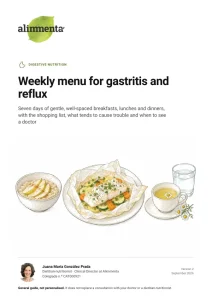
Your week of gentle meals for your stomach
- 7-day menu with gentle, spread-out meals
- 8 recipes and the shopping list
- What tends to cause trouble and when to see a doctor
Where should we send it?
Free PDF, in your inbox in a moment.
Data controller: Alimmenta Tu Vida, S.L. Purpose: to send you the guide and, only if you tick the second box, tips by email on the topic. You can withdraw your consent and exercise your rights at [email protected]. Legal basis, recipients and retention periods are in our privacy policy.
When to see a doctor
When to see a doctor
With food and habits we ease the symptoms of a hiatus hernia and avoid what makes them worse. What we cannot do is close the hiatus, find out what is behind the heartburn or adjust medication. That is done by your doctor, with the appropriate test.
Book a medical appointment without waiting to change your diet if you notice any of these signs:
- You vomit blood, or bring up something dark like coffee grounds [7]
- Your stools are black like tar, or have blood in them [7]
- You struggle to swallow, it hurts to swallow or you feel food getting stuck [7]
- You lose weight without trying to, with stomach pain or repeated vomiting [1]
- You notice paleness and more tiredness than usual, for no reason [7]
- The pain wakes you at night, or does not settle within two weeks even though you are on treatment [4]
If you vomit blood, pass black stools or the pain comes on suddenly and is severe, go to the emergency department today. If you struggle to swallow, lose weight without trying to or notice paleness and more tiredness than usual for no reason, book an appointment with your GP this week [7]. If the pain wakes you at night or does not settle within two weeks, talk to your doctor this week.
Most hiatus hernias never get this far. Knowing when to seek help is part of looking after yourself.

Bring your medical reports and we will review them with you at your first appointment
With your diagnosis and test results in front of us, we go through what you eat on a typical day. You leave with initial recommendations and a symptom diary to keep that week. At your second appointment, you receive your eating plan.
Keep reading

Diet for gastro-oesophageal reflux: what to eat and what to change
Your chest burns after eating, you have a dry cough and you sleep badly. In many cases, the…
Gastritis diet: what to eat and what to avoid
Before every meal you wonder how you are going to feel afterwards, and you end up eating fewer…

Diarrhoea: what to eat, what to avoid and when to see a doctor
You have had loose stools for several days and wonder whether you should eat only rice or stop…
 Consultation
Digestive dietitian in Barcelona and online
Improving your symptoms starts with understanding your digestion
Book a visit →

Sources
- Katz PO, Dunbar KB, Schnoll-Sussman FH, et al. ACG Clinical Guideline: Guidelines for the Diagnosis and Management of Gastroesophageal Reflux Disease. Am J Gastroenterol. 2022;117(1):27-56. doi:10.14309/ajg.0000000000001538
- Martin Z, Spry G, Hoult J, et al. What is the efficacy of dietary, nutraceutical, and probiotic interventions for the management of gastroesophageal reflux disease symptoms? A systematic literature review and meta-analysis. Clin Nutr ESPEN. 2022;52:340-352. doi:10.1016/j.clnesp.2022.09.015
- Simadibrata DM, Lesmana E, Amangku BR, et al. Left lateral decubitus sleeping position is associated with improved gastroesophageal reflux disease symptoms: A systematic review and meta-analysis. World J Clin Cases. 2023;11(30):7329-7336. doi:10.12998/wjcc.v11.i30.7329
- National Institute for Health and Care Excellence. Gastro-oesophageal reflux disease and dyspepsia in adults: investigation and management (CG184). NICE; 2014, updated in 2019. https://www.nice.org.uk/guidance/cg184
- Muftah M, McCarty TR, Hartnett D, et al. Association of Coffee Intake With Risk of Gastroesophageal Reflux Disease and Complications: A Systematic Review and Meta-Analysis. Clin Transl Gastroenterol. 2026;17(4):e00996. doi:10.14309/ctg.0000000000000996
- Yu C, Wang T, Gao Y, et al. Association between physical activity and risk of gastroesophageal reflux disease: a systematic review and meta-analysis. J Sport Health Sci. 2024;13(5):687-698. doi:10.1016/j.jshs.2024.03.007
- National Institute for Health and Care Excellence. Suspected cancer: recognition and referral (NG12). NICE; 2015, updated in 2026. https://www.nice.org.uk/guidance/ng12
Written and reviewed by


How we can help
Now, applied to you
Digestive dietitian in Barcelona and onlineImproving your symptoms starts with understanding your digestion
4.9 on Google · 5.0 on Doctoralia · 2,047 reviews