You can eat
- Grains and tubers: rice, pasta and potato.
- Meat and fish: chicken, turkey and white fish; depending on how it sits with you, oily fish.
- Lean cold meats: cooked ham and turkey breast.
- Egg: poached, hard-boiled or as a lightly cooked plain omelette.
- Dairy: skimmed or semi-skimmed milk, skimmed yoghurt and fresh soft cheese.
- Vegetables: boiled, baked or puréed if raw ones feel heavy; garlic and onion well sweated if you tolerate them.
- Fruit: ripe, baked or as compote.
- Pulses: well cooked and, if they disagree with you, passed through a food mill.
- Drinks: water, gentle stocks with the fat removed, non-citrus juices and infusions of camomile, lemon balm or lemon verbena.
- Cooking and fat: boiling, steaming, baking and en papillote, with olive oil for cooking and dressing.
What to avoid
- Fats: fried food, battered food, fatty stews, cream sauces, pastries and chocolate.
- Fatty cuts of meat, and fatty cured sausages such as chorizo, salchichón or sobrasada.
- Dairy: whole milk, cream and mature cheeses.
- Acidic foods: tomato, citrus fruit and unripe fruit.
- Alcohol: avoid it. Fizzy drinks: avoid the ones that disagree with you.
- Coffee, decaffeinated included: avoid it. Tea: stop it if it bothers you and try it again when you improve.
- Gas-forming or raw vegetables, if they repeat on you: artichoke, cabbage, cauliflower, broccoli, Brussels sprouts, pepper, cucumber, and raw onion and garlic.
- Strong seasonings: hot spice, vinegar-cured dishes, spices and concentrated stocks.
- Extreme temperatures: nothing very cold or very hot.
- The burnt parts of food cooked on the griddle or the grill.
Changes that help
Fats and fried food
Instead of frying or coating food in batter, bake, steam or cook en papillote, because fat slows stomach emptying.
Breakfast
Instead of orange juice at breakfast, have ripe fruit or fruit compote, because ripe or cooked fruit loses much of its acidity.
Vegetables
Instead of removing a vegetable that feels heavy when raw, eat it boiled or as a puréed soup, because it is usually the texture that causes discomfort.
Stocks and salt
Instead of a concentrated stock cube, have a gentle homemade stock with the fat removed, because a lot of salt slips in unnoticed with the cube.
Habits that help
- Eat slowly and chew well.
- Have dinner at least two or three hours before going to bed; if you get hungry afterwards, make it something that is not solid.
- If you smoke, give it up; tobacco is among the clearest triggers [2].
- If you are carrying extra weight, bringing it down gradually is part of the advice for dyspepsia [2].
- Find a moment in the day to lower the revs; ongoing stress tends to make symptoms worse.
Gastritis is inflammation of the lining of the stomach. It can be acute, if it lasts a few days, or chronic, if it drags on for months or years. You notice it as pain or burning in the pit of the stomach, nausea and sometimes vomiting.
With what you eat you can ease the discomfort in your stomach while it recovers and avoid what makes it worse. Removing the cause is another matter. If there is a Helicobacter pylori infection behind it, which is the most common situation, your doctor treats it [1] [3].
Why do I have gastritis?
The most common cause is a bacterium, Helicobacter pylori, which passes from person to person. The Spanish consensus identifies it as the main cause of chronic gastritis, peptic ulcer and gastric cancer, and estimates that it affects around half of the world’s population [3].
Having the bacterium does not mean you notice it. The infection always inflames the stomach, with or without symptoms, and only some of the people who have it come to notice it or develop complications [1]. That is why many people are diagnosed with gastritis during an endoscopy done for another reason.
It is not the only cause. Others are:
- Taking anti-inflammatories such as aspirin or ibuprofen continuously.
- Drinking too much alcohol, and smoking.
- Ongoing stress or anxiety, which make the symptoms worse.
- Large, very fatty or very spicy meals, repeated over time.
- Food-borne infections and some viral ones.
- Autoimmune disorders such as pernicious anaemia.
None of this is your fault. Of that list, three things can be changed this week: smoking, alcohol and the anti-inflammatories you take on your own. They are the ones that change the picture most.
Is it gastritis, acid reflux or a hiatus hernia?
They get confused constantly, and the difference matters because the advice is not the same. The most useful clue is where it burns and when.
- Gastritis: the wall of the stomach is inflamed. It hurts or burns in the pit of your stomach, and tends to show up on an empty stomach or a while after eating something irritating.
- Acid reflux: the contents of the stomach rise into the oesophagus. It burns behind the breastbone and rises towards the throat, and it gets worse when you lie down and after dinner. If that is your case, the advice is in the diet for gastro-oesophageal reflux.
- Hiatus hernia: part of the stomach passes into the chest through the hiatus, the opening in the diaphragm that the oesophagus passes through. Often it gives no symptoms of its own: what gives them is the reflux it makes easier. There, timing and posture are what count, and it has its own diet for hiatus hernia.
- Gastroenteritis. It gets confused with gastritis only because of the name. Gastritis is inflammation of the stomach; gastroenteritis, of the stomach and the intestines. That is why it adds diarrhoea, and often fever and general malaise. It usually comes from an infection that passes in a few days, and the first thing then is to stay well hydrated.
They can occur together, and that is the most common situation. A hernia makes reflux easier in someone whose stomach is also irritated. The British clinical guidelines deal with dyspepsia and reflux in the same document [2], and much of this advice works for all three. But if Helicobacter is behind it, there is also a cause to treat. If what predominates is diarrhoea that does not go away, the cause may be something else and your doctor should look into it. If you are diagnosed with Crohn’s disease, there is the diet for Crohn’s disease, with advice for flare-ups and for remission.
Are gastritis and an ulcer the same thing?
No. Gastritis is an inflamed stomach wall; an ulcer is a sore that has broken through that wall. One can turn into the other if the cause is still there. Both share causes: the same bacterium [3] and, right behind it, anti-inflammatories.
The practical difference is who diagnoses it and with what. An ulcer is seen at an endoscopy and its follow-up is medical. Gastritis, on the other hand, is very often named without anything having been looked at. For what you eat, this advice works the same in both cases. With a diagnosed ulcer, though, medical follow-up is not optional.
Does gastritis go away?
It depends on the cause. If Helicobacter pylori is behind it, the European consensus on this bacterium is clear. Eradicating it calms the inflammation and stops gastritis from progressing to atrophy [1]. Once atrophy is established, it can reverse in some cases, not in all [1].
The bacterium is eliminated with a treatment that your doctor prescribes. It is several antibiotics and a proton pump inhibitor, the stomach protector, usually for fourteen days [3] [4]. So if you have had discomfort for a while and nobody has tested you for Helicobacter, asking for the test is more useful than changing your breakfast again.
And if there is no bacterium? Then the most common situation is functional dyspepsia, which means the same symptoms without a lesion to explain them. There is nothing to eradicate, and food, schedules and rest become the main tool.
What is good for gastritis?
The evidence on food and stomach symptoms is scant and of low quality, and it is worth saying so. An analysis of eleven studies found that spicy food is associated with more discomfort [5]. It also found that eating four or more times a day is associated with fewer symptoms than eating twice or less [5]. Almost all of those studies were done in Asia, and the authors themselves urge caution before turning it into a rule [5].
The British clinical guidelines do not give a universal list either. They advise avoiding what you notice disagrees with you, and they name tobacco, alcohol, coffee, chocolate and fatty food [2]. There is no safe amount of alcohol for health (WHO): the less, the better. During pregnancy, breastfeeding and childhood, no alcohol at all. Do not drink either if you are going to drive or your medication does not allow it.
On your plate, it makes sense to spread your meals out, reduce fat and cut back on spicy food. A long list of foods to exclude ‘just in case’ does not. Do not restrict your diet more than necessary.
How many meals a day, and at what time?
Four or five small meals a day usually sit better than two large ones. It is what we recommend in clinic and what that analysis of eleven studies points to, with the same caution as before [5]. With less volume each time, the stomach has less acid and less pressure to handle.

Include breakfast, at whatever time suits you, unless it sits badly or does not fit your day. Timing also matters for dinner. Lying down on a full stomach encourages heartburn, which is why dinner goes early and light. If you get hungry afterwards, choose something that is not solid, such as a warm infusion.
Do you have to give up coffee, tomato and milk?
They are the three questions we are asked most in consultations, and each has its own answer.
- Coffee and tea. Avoid coffee, decaffeinated included. With tea, test your tolerance: stop it if it causes discomfort and try it again when you improve. The guidelines list them among possible triggers [2].
- Tomato and citrus fruit: they are acidic and they bother a lot of people, especially raw and at night. Before removing them altogether, try tomato cooked and in small amounts, and move them to midday.
- Milk. Skimmed or semi-skimmed usually sits well, and so do skimmed yoghurt and fresh soft cheese. What tends to bother is the fat in the dairy. If you prefer a plant-based drink, the best is soy or one with at least 3% protein, which you can check on the label. Keep in mind that soy is an allergen.
If you are on treatment for Helicobacter
The treatment is prescribed by your doctor and normally lasts fourteen days [3]. What we can do through food is help you get to the end of it.
And it is not a detail. Almost everyone completes the treatment: in a European registry of more than 38,000 treatments, only 1.7% did not [6]. But not completing it comes at a high cost. In that registry, the bacterium was eliminated in 89% of those who completed the full treatment and in 58% of those who did not [6]. Stopping halfway was more frequent with long regimens, in rescue treatments and with adverse effects [6]. That is where food helps during those fourteen days.
- Small, frequent meals with neutral flavours. If a metallic taste or nausea shows up, rice, potato, bread and cooked fruit usually go down better than anything with a strong smell.
- Drink often and in small amounts, especially if there is diarrhoea, and do not force food on the day it will not go down.
- No alcohol during the treatment.
- Do not skip meals to make up for a bad day: getting to the next one without having eaten is what makes it worse.
What is not decided at home is skipping a dose because it feels awful that day. Tell whoever prescribed it, who has alternatives if the first regimen is not tolerated [3]. If you struggle to eat on those days and lose weight, a digestive dietitian can help you adjust it.
If you have been told you have atrophic gastritis
Atrophic gastritis is a chronic gastritis that, over the years, thins the lining of the stomach. It often appears in a biopsy report next to the word “precancerous”, and it frightens people more than it deserves. The European guideline on these lesions, updated in 2025, makes three points clear [7].
- In most cases no follow-up endoscopy is needed. This applies when the atrophy is mild or moderate, limited to the lower part of the stomach and not autoimmune, with no other risk factors. That group is most of what is seen in practice [7].
- If Helicobacter is present, it is eradicated, and the sooner the better. This is recommended with or without atrophy to reduce the risk of gastric cancer, and the benefit is greater if no established lesions are present yet [7].
- Autoimmune gastritis does need follow-up. The guideline proposes a surveillance endoscopy every three years, even if the atrophy is mild [7]. In its advanced stage vitamin B12 can run short and pernicious anaemia can appear [7]. Your doctor monitors B12 in your blood tests and prescribes the supplement if needed. Do not supplement on your own: without a blood test there is no way to know whether you are short. With us, your eating is adjusted to your needs.
No food reverses atrophy. What helps is removing whatever keeps it going.
Is there such a thing as nervous gastritis?
Under that name it does not appear in clinical guidelines. What does exist, and is very common, is having symptoms without a lesion that explains them: functional dyspepsia. There, stress, sleep and rushing your meals weigh heavily, even though the stomach looks normal.
Ongoing stress acts mainly by changing how the stomach moves and how much you notice of what goes on in it. Eating standing up in ten minutes, having dinner at eleven and sleeping five hours make the symptoms worse in any stomach. And that you can change this week.
What mistakes do we see in consultations?
- Changing your diet without ever having been tested for Helicobacter. It is the costliest mistake, because people spend months eating boiled rice with a treatable infection there.
- Living on boiled rice and chicken breast for months. The diet ends up poor, the burning carries on and there is no longer any way of knowing what was disagreeing with you.
- Removing twenty foods at once. You learn nothing that way. Remove the suspect foods for a week or two and reintroduce them one at a time.
- Leaving pulses and vegetables out after one bad episode and never trying them again. Before removing them, change the form: boiled, puréed, without skins.
- Using milk as an antacid every time the burning appears. It soothes for a while and fixes nothing, and if it is whole milk it adds fat to a digestion that is already slow.
- Having black coffee for breakfast, on an empty stomach and standing up. It is the combination that comes up most often when you go through the day of someone who says they eat nothing out of the ordinary.
- Confusing “it disagrees with me” with “it harms me”. A food that bothers you one day does not have to leave your life. One that bothers you three times out of three does, at least for now.
- Stopping the stomach protector as soon as you feel better, without telling anyone, and carrying on with the ibuprofen. That prescription is your doctor’s, who can also check whether another medicine is affecting your stomach [2].
- Confusing gastritis with reflux. If what burns is your chest and it rises towards the throat, look at the diet for gastro-oesophageal reflux. If you have been found to have a hiatus hernia, that has its own advice on timing and posture.
If you eat well and still feel the same
It happens, and it does not mean you are doing it wrong. Food eases the symptoms and avoids what makes them worse, but it does not remove the cause and it does not replace a treatment.
If you have spent weeks spacing out your meals, with no fried food or spice and having dinner early, and you still have pain or burning almost every day, review it with your doctor. Ask whether you have been tested for Helicobacter and with which test, whether any medicine you take may be behind it [2] and whether the stomach protector is well adjusted.
Alongside that, your eating is adjusted case by case. With night shifts, with little time to eat or after months of eating four things, general advice falls short. We work on that with you in the digestive dietitian consultation.
We explain it on video
Your first step this week
Note what you eat and how it agrees with you
For seven days, note what you eat and how it agrees with you. At the end of the week you will see what recurs and have something specific to take to a consultation or to your doctor.
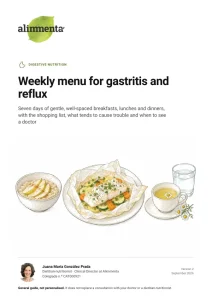
Your week of gentle meals for your stomach
- 7-day menu with gentle, spread-out meals
- 8 recipes and the shopping list
- What tends to cause trouble and when to see a doctor
Where should we send it?
Free PDF, in your inbox in a moment.
Data controller: Alimmenta Tu Vida, S.L. Purpose: to send you the guide and, only if you tick the second box, tips by email on the topic. You can withdraw your consent and exercise your rights at [email protected]. Legal basis, recipients and retention periods are in our privacy policy.
When to see a doctor
When you should see a doctor
With food we ease the symptoms and avoid what makes them worse. What we cannot do is diagnose gastritis or treat its cause — often a Helicobacter pylori infection: that is your doctor’s job.
Seek medical attention without waiting to change your diet if you notice any of these signs:
- You vomit blood, or bring up something dark like coffee grounds [8].
- Your stools are black like tar, or have blood in them [8].
- You struggle to swallow, it hurts to swallow or you feel food getting stuck [8].
- You lose weight without trying to, with stomach pain or repeated vomiting [9].
- You notice paleness and more tiredness than usual, for no reason [8].
- The pain wakes you at night, or does not settle within two weeks even though you are on treatment [2].
If you vomit blood, pass black stools or the pain comes on suddenly and is severe, go to the emergency department today. If you struggle to swallow, lose weight without trying to or notice paleness and more tiredness than usual for no reason, book an appointment with your GP this week [8]. If the pain wakes you at night or does not settle within two weeks, talk to your doctor this week.
Most cases of gastritis never get this far. Knowing when to seek help is part of looking after yourself.

Bring your medical reports and we will review them with you at your first appointment
With your diagnosis and test results in front of us, we go through what you eat on a typical day. You leave with initial recommendations and a symptom diary to keep that week. At your second appointment, you receive your eating plan.
Keep reading

Hiatus hernia diet: what to eat and how to have dinner
If every dinner ends in heartburn and broken nights, you are not doing it wrong. With a hiatus…
Diet for gastro-oesophageal reflux: what to eat and what to change
Your chest burns after eating, you have a dry cough and you sleep badly. In many cases, the…
Bland diet: what to eat, how long, when to eat normally
Your stomach has been unsettled for hours, and you are wondering whether to have only broth, make some…
 Resource hub
Other digestive conditions: nutrition guides
Find a guide for your situation and ask your medical team which changes to your diet are right…
- Consultation
Digestive dietitian in Barcelona and online
Improving your symptoms starts with understanding your digestion
Book a visit →




Sources
- Malfertheiner P, Megraud F, Rokkas T, et al. Management of Helicobacter pylori infection: the Maastricht VI/Florence consensus report. Gut. 2022;71(9):1724-1762. doi:10.1136/gutjnl-2022-327745
- National Institute for Health and Care Excellence. Gastro-oesophageal reflux disease and dyspepsia in adults: investigation and management (CG184). NICE; 2014, actualizada en 2019. https://www.nice.org.uk/guidance/cg184
- Gisbert JP, Alcedo J, Amador J, et al. V Conferencia Española de Consenso sobre el tratamiento de la infección por Helicobacter pylori. Gastroenterol Hepatol. 2022;45(5):392-417. doi:10.1016/j.gastrohep.2021.07.011
- Chey WD, Howden CW, Moss SF, et al. ACG Clinical Guideline: Treatment of Helicobacter pylori Infection. Am J Gastroenterol. 2024;119(9):1730-1753. doi:10.14309/ajg.0000000000002968
- Ostadsharif N, Haghighatdoost F, Forooshani MA, et al. Association between dietary habits and risk of functional dyspepsia: a systematic review and meta-analysis of observational data. J Health Popul Nutr. 2026;45:54. doi:10.1186/s41043-025-01223-4
- Huguet JM, Ferrer-Barceló L, Suárez P, et al. Role of compliance in Helicobacter pylori eradication treatment: Results of the European Registry on H. pylori management. United European Gastroenterol J. 2024;12(6):691-704. doi:10.1002/ueg2.12569
- Dinis-Ribeiro M, Libânio D, Uchima H, et al. Management of epithelial precancerous conditions and early neoplasia of the stomach (MAPS III): European Society of Gastrointestinal Endoscopy (ESGE), European Helicobacter and Microbiota Study Group (EHMSG) and European Society of Pathology (ESP) Guideline update 2025. Endoscopy. 2025;57(5):504-554. doi:10.1055/a-2529-5025
- National Institute for Health and Care Excellence. Suspected cancer: recognition and referral (NG12). NICE; 2015, actualizada en 2026. https://www.nice.org.uk/guidance/ng12
- Katz PO, Dunbar KB, Schnoll-Sussman FH, et al. ACG Clinical Guideline: Guidelines for the Diagnosis and Management of Gastroesophageal Reflux Disease. Am J Gastroenterol. 2022;117(1):27-56. doi:10.14309/ajg.0000000000001538
Written and reviewed by


How we can help
Now, applied to you
Digestive dietitian in Barcelona and onlineImproving your symptoms starts with understanding your digestion
4.9 on Google · 5.0 on Doctoralia · 2,047 reviews