

You can eat
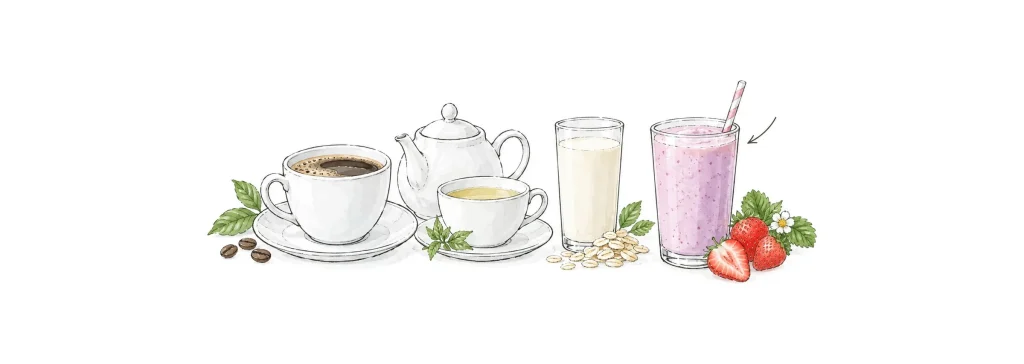
- Black coffee, coffee with a dash of milk or coffee with milk, with no added sugar
- Black, green or red tea, on its own or with a little milk
- Mild chamomile, lemon balm or lemon verbena infusions, hot or cold
- Milk or plain drinking yoghurt, with no added sugars
- Soy or another plant-based drink with at least 3 g of protein per 100 ml, with no added sugars.
- A homemade smoothie made with whole fruit and milk, yoghurt or kefir
- Water, plain or with a few slices of lemon or orange
What to avoid
- Coffee with sugar, syrups or whipped cream as an everyday habit
- Coffee capsules or mixes with already-sweetened powdered milk
- Sugared instant cocoa as your every-morning drink
- Packaged juices and nectars, including those labelled “no added sugars”
- Freshly squeezed orange juice instead of whole fruit, every day.
- Energy drinks and caffeinated soft drinks
Changes that help
Coffee with sugar
Instead of adding two sachets of sugar to your coffee, remove half a sachet each week; your taste buds adapt and your free sugar intake for the day goes down
Every-morning juice
Instead of having orange juice every day, eat a whole orange in segments, because it retains its fibre and is more filling
Sweetened cocoa
Instead of sweetened instant cocoa, add unsweetened pure cocoa powder to milk, because you keep the flavour without the added sugar
Capsules with powdered milk
Instead of coffee capsules with milk that are already sweetened, have an espresso with milk, so you decide how much sugar it contains
Habits that help
- Sit down for breakfast, even if only for ten minutes
- If you find it hard to fall asleep, have your last coffee of the day before lunch.
- Keep water in sight from the moment you get up: a glass before coffee counts too.
Questions about coffee come up again and again in consultations: is it healthy, how many cups can you have, does it raise blood pressure, and should you stop drinking it during pregnancy? Then there are questions about tea, herbal infusions, milk, smoothies and the juice people have every morning.
Almost all these drinks can be part of a balanced breakfast. What makes the difference is the amount of caffeine, any sugar added, and whether the fruit is eaten whole or juiced.
Is it healthy to have coffee with breakfast?
Yes, for most healthy adults. A review analysing more than two hundred meta-analyses concluded that moderate coffee consumption is safe and is associated with lower mortality and less cardiovascular disease [2]. It notes two exceptions: pregnancy and women at high risk of fracture [2]. These are observational studies: they show an association, not that coffee itself is protective. Based on current evidence, coffee is not something you need to compensate for or routinely avoid.
How much caffeine is in a cup of coffee?
It depends on how it is prepared and the type of bean. As a guide, the European Food Safety Authority (EFSA) estimates that a 60 ml espresso contains about 80 mg of caffeine [3]. A 200 ml cup of filter coffee contains about 90 mg, and a 220 ml cup of black tea about 50 mg [3]. Chocolate and cola drinks also contribute caffeine, in smaller amounts [3]. Decaffeinated coffee retains only a minimal amount.
How many coffees can you have a day?
For healthy adults, up to 400 mg of caffeine a day, spread throughout the day, does not raise safety concerns, according to EFSA [1]. Nor do single doses of up to 200 mg [1], or about two and a half espressos [3]. In practice, that is around four cups of filter coffee or five espressos a day [3].
The same scientific opinion warns that around 100 mg close to bedtime may delay sleep and shorten it in some people [1]. If you sleep poorly, first consider what time you have your last coffee before focusing on how many you drink.
Who should limit coffee?
In some situations, it may be advisable to have less or switch to decaffeinated coffee. This is not an exhaustive list, and the decision should be made with your doctor.
- Pregnancy and breastfeeding. During pregnancy, the reference is to stay below 200 mg of caffeine a day from all sources [1], or around two cups of filter coffee [3]. During breastfeeding, up to 200 mg of caffeine a day is also not considered a concern for the baby [1]. Pregnancy is also one of the two exceptions noted in the review on coffee and health [2].
- Uncontrolled high blood pressure. Caffeine can temporarily raise blood pressure, especially in people who do not drink it every day. If your blood pressure is not controlled, talk to your doctor before continuing or increasing your coffee intake. For the rest of your eating plan, see our guide to eating with hypertension.
- Reflux. The American reflux guideline advises avoiding foods that trigger symptoms [4]. Coffee is often among those mentioned [4]. If you have reflux, avoid coffee.
- Anxiety or nervousness. If you notice palpitations, trembling or increased restlessness after coffee, reduce the amount or switch to decaffeinated coffee.
- Children and teenagers. Coffee is not a suitable breakfast drink for them. As a cautious reference, they should stay below 3 mg of caffeine per kilogram of body weight per day, counting cola drinks, chocolate and energy drinks [1].
If you take medication, ask your pharmacist or doctor whether coffee interacts with it; do not change your medication on your own.
How to have coffee as part of a balanced breakfast
What often takes away from coffee is what goes into it. The World Health Organization (WHO) recommends that free sugars provide no more than 10% of daily energy, and ideally no more than 5% [5]. These include sugars added to foods and drinks, as well as those in honey, syrups and fruit juices [5]. Two or three coffees with two sachets of sugar each already use a substantial part of that allowance.
Many capsules and powdered-milk coffee mixes already contain sugar even if you do not add any yourself; check the ingredients list.
If you do not want coffee: tea, herbal infusions or milk
Black, green and red tea all come from the same plant and contain caffeine, traditionally called theine in tea. A cup of black tea provides a little over half as much caffeine as a cup of filter coffee [3]. Mild infusions, such as chamomile, lemon balm or lemon verbena, are a good option if you want a hot drink without caffeine. Have them without sugar, just like coffee.
Milk can also be part of breakfast, on its own or flavoured: warm it without bringing it to the boil, with a cinnamon stick and orange peel or a vanilla pod. If you do not have dairy, in consultations we recommend soy drink, or a plant-based drink with at least 3 g of protein per 100 ml and added calcium. Bear in mind that soy is an allergen. We explain what else to look for on the label in plant-based drinks: which one to choose.
Fruit smoothie, juice or cocoa: which is better at breakfast?
Whole fruit, eaten and chewed, is the best way to have fruit. A homemade smoothie made by blending whole fruit retains its fibre and, with milk, yoghurt or kefir, can make a complete breakfast. There is one limitation: it is quicker to drink and less filling than chewed fruit, so it should not replace all the fruit you eat during the day.
Juice is different. WHO counts the sugars in fruit juice, including fresh-squeezed juice, as free sugars, just like table sugar [5]. You do not need to eliminate it; simply avoid making it your everyday morning fruit.
Sugared cocoa powder usually lists sugar as its first ingredient; check the label. Water is the drink of choice as part of a healthy diet [6].
Common mistakes we see in consultations
Three things we often hear, and what may be behind them.
- “I only have two coffees.” A milky coffee in a large cup may contain a double espresso. To work out how much caffeine you have, count the espresso shots in each cup, not just the cups.
- “I switched to tea to have less caffeine.” That is fine, as long as you are not having five cups a day: at around 50 mg each [3], they add up to almost as much as three filter coffees.
- “Coffee keeps me going until midday.” That can work, but it leaves out the rest of breakfast. If you do not feel like eating when you get up, have breakfast later. Start with something small, such as a yoghurt or a piece of fruit, and add more when you feel like it. Find ideas in how to put together healthy, balanced breakfasts.
Coffee is not the enemy of breakfast, and juice is not the same as fruit. Keep those two ideas in mind and pay a little attention to sugar, and you will know what to choose for breakfast.
If you have high blood pressure, elevated cholesterol or questions about coffee and your medication, we can help. Our metabolic health nutrition team can tailor your breakfast and the rest of your day with you, in Barcelona or online, in coordination with your doctor.
Your first step this week
Kefir, strawberry and kiwi smoothie
Tomorrow, blend 200 ml of plain kefir with one kiwi and two or three strawberries, and have it with a slice of wholemeal toast.

Your Mediterranean week to look after your cholesterol
- 7-day menu with the shopping list
- 8 Mediterranean recipes
- How to read labels and what to order when eating out
Where should we send it?
Free PDF, in your inbox in a moment.
Data controller: Alimmenta Tu Vida, S.L. Purpose: to send you the guide and, only if you tick the second box, tips by email on the topic. You can withdraw your consent and exercise your rights at [email protected]. Legal basis, recipients and retention periods are in our privacy policy.
When to see a doctor
When to see a doctor
This guidance is for breakfast for healthy adults. If you are pregnant, have high blood pressure or reflux, experience palpitations after coffee, or take medication every day, discuss how much coffee is appropriate for you with your doctor.
If you have high blood pressure, the signs that need prompt medical attention are covered in our guide to eating with hypertension.
For most people, breakfast drinks are not a reason to seek medical advice; adjusting the amount of coffee and sugar is enough.

Tell us what your week looks like and what you would like to change
At the first visit we talk about your schedule, who cooks at home and what you have tried before. At the second visit you receive your plan in writing.
Keep reading

Diet for hypertension: what to eat to lower blood pressure
You have been told your blood pressure is high, you feel fine, and the only instruction you took…
Plant-based drinks: which to choose and what to look for on the label
You have stopped drinking milk, or want to drink less, and the supermarket shelf has twenty cartons that…
Healthy, balanced breakfasts: the method and a full week
During the week, breakfast is sorted in five minutes with whatever is in the kitchen. And by eleven…
Sparkling water: is it as healthy as tap water?
You prefer it to plain water and it helps you drink more, but you have heard that it…
Digestive biscuits: what they contain and how to choose them
You choose them because they seem like the sensible option in the biscuit aisle, with their rustic look…
 Consultation
Dietitian to help you eat better in Barcelona and online
Learn to eat better, with shopping, menus and cooking that fit your week and no lists of foods…
Book a visit →


Recipes for this goal


Sources
- EFSA Panel on Dietetic Products, Nutrition and Allergies (NDA). Scientific Opinion on the safety of caffeine. EFSA Journal. 2015;13(5):4102. doi:10.2903/j.efsa.2015.4102
- Poole R, Kennedy OJ, Roderick P, et al. Coffee consumption and health: umbrella review of meta-analyses of multiple health outcomes. BMJ. 2017;359:j5024. doi:10.1136/bmj.j5024
- European Food Safety Authority (EFSA). Caffeine (topic page). Parma: EFSA; accessed 24/09/2026. Available at: https://www.efsa.europa.eu/en/topics/topic/caffeine
- Katz PO, Dunbar KB, Schnoll-Sussman FH, et al. ACG Clinical Guideline for the Diagnosis and Management of Gastroesophageal Reflux Disease. Am J Gastroenterol. 2022;117(1):27-56. doi:10.14309/ajg.0000000000001538
- World Health Organization. Guideline: sugars intake for adults and children. Geneva: World Health Organization; 2015. Available at: https://www.who.int/publications/i/item/9789241549028
- López García E, Bretón Lesmes I, Díaz Perales A, et al. Report of the Scientific Committee of the Spanish Agency for Food Safety and Nutrition (AESAN) on sustainable dietary recommendations and physical activity recommendations for the Spanish population. Revista del Comité Científico de la AESAN. 2022;36:11-70. Available at: https://www.aesan.gob.es/dam/jcr:3abe8c98-559f-4cac-8b10-506b89590229/INFORME_RECOMENDACIONES_DIETETICAS.pdf
Written and reviewed by


How we can help
Now, applied to you
Dietitian to help you eat better in Barcelona and onlineLearn to eat better, with shopping, menus and cooking that fit your week and no lists of foods you can't have, in Barcelona and online.
4.9 on Google · 5.0 on Doctoralia · 2,072 reviews
