You can eat
- Vegetables: courgette, green bean, carrot, pumpkin, spinach and skinless tomato, better cooked than raw.
- Fruit: banana, orange, mandarin, kiwi, strawberries and grapes, spread throughout the day.
- Cereals and tubers: rice, potato, well-cooked pasta, oats and toast.
- Protein: white and oily fish, chicken, turkey and egg, according to your preferences and tolerance.
- Pulses: as a cream, purée or hummus, starting with small portions.
- Dairy: choose products and amounts you tolerate; if you suspect lactose intolerance, check with your doctor before removing the group.
- Drinks: water. Drink according to thirst, activity and the advice of your healthcare team.
- Herbal teas: chamomile or lemon balm, if you like them, without attributing any therapeutic effect to them.
- Seasonings: cumin, bay leaf or clove, if you like them; they do not replace an assessment of your symptoms.
- Cooking methods: boiled, steamed, oven-baked and en papillote (wrapped in baking paper).
What to avoid
- Fizzy drinks: soft drinks, sparkling water and beer.
- Sweeteners ending in «-ol», such as sorbitol, mannitol, xylitol and maltitol, found in chewing gum and «sugar-free» products.
- Gas-producing vegetables in large amounts: cabbage, cauliflower, broccoli, artichoke, pepper and onion.
- Large, fatty meals, fried foods and battered dishes, which prolong the feeling of a full belly.
- Chewing gum and straws: notice whether using them makes you swallow more air and increases your discomfort.
- Sudden increases in fiber: wholegrain, pulses or bran all at once.
- Alcohol.
Changes that help
Drinks
Instead of soft drinks or sparkling water at mealtimes, still water, so you can see whether the drink makes a difference.
Pulses
Instead of removing the pulse, try a different amount or texture, because your tolerance may depend on how you eat it.
Vegetables
Instead of removing cabbage, cauliflower or broccoli, try a different portion or way of cooking, because tolerance is personal.
Sweets and chewing gum
Instead of chewing gum or sweets containing polyols, go without them for a few days, because they can increase gas [2].
Habits that help
- Eat slowly and chew well.
- If it suits you, walk a little after eating.
- If your belly bulges outward, check with your team whether diaphragmatic breathing suits you [1].
- If you have constipation, mention it to your doctor: it may be part of managing the bloating [1].
- If you smoke and want to quit, ask your healthcare team for help.
Bloating is one of the complaints heard most often in consultation, and one of the most poorly explained outside it. What a search usually returns is a list of foods to avoid, a tea or a shake.
What usually happens is that you eat fewer and fewer things and your belly stays the same. Understanding why it swells almost always helps more than removing another food.
Why does my stomach swell?
In visible distension, the increase in gas can be small and on its own may not explain how much the belly grows [1]. The diaphragm drops and the abdominal wall relaxes outward. There may also be greater intestinal sensitivity.
That is why bloating and gas are not the same, although they often go together. Having gas is normal, and so is passing it. Some foods ferment in the colon and can produce gas; in other people, the main response is the abdominal wall’s reaction to the intestinal contents.
And there is a third route that is often forgotten: the air you swallow when eating quickly or talking while you eat.
Why do I look pregnant if I have not gained weight?
It is one of the questions people search for most, and it has an explanation. When the intestine fills, the usual response is for the diaphragm to rise and the abdominal wall to move inward.
The opposite can happen. The diaphragm drops and the abdominal wall relaxes outward, and the same contents take up much more space in front. The belly shows, can be measured, and you cannot do up your trousers, without having gained a gram of fat.
This reflex is called abdominophrenic dyssynergia. The expert review by the American Gastroenterological Association describes diaphragmatic breathing as an option for working on it [1]. Your team can assess whether it suits your case.
Timing also plays a part. Distension can vary over the course of the day; the time of day alone does not show the cause.
Is it bloating, fat or fluid retention?
«Feeling bloated» covers three different things, and they are not treated the same way.
- Abdominal distension. A visible increase in abdominal volume. It can vary during the day, but that pattern alone does not identify the cause.
- Abdominal fat. It does not change from morning to night or with what you had for dinner yesterday. It is managed differently, and slowly.
- Fluid retention. If you notice swelling in your legs, ankles, hands or face, note it down and discuss it with your doctor. The time of day or the location of the swelling does not identify the cause on its own.
If your belly changes size between breakfast and dinner, it may be abdominal distension; your doctor will assess other causes if needed. If you also have heartburn or reflux, see the gastritis diet.
What bloats most and how to eat it without giving it up
What bloats most tends to have something in common. Cabbages, onion, pulses and sweeteners ending in «-ol» contain sugars or fibers that the small intestine absorbs poorly. When they reach the colon they ferment and produce gas. If they upset you particularly, see the sorbitol intolerance guide.
What bloats is cooked differently before you think about removing it.
Nutritious foods such as pulses and vegetables can cause discomfort in some people. Try changing the portion and the cooking method before removing them; the response varies from person to person.
The same goes for fiber. The European Food Safety Authority considers 25 grams of fiber a day appropriate for adults [3]. It is a population reference, not an individual prescription. How you get there matters as much as the figure. It is best to increase it gradually.
In irritable bowel, psyllium is an option of soluble fiber [4]. Your doctor or your registered dietitian will tell you whether it suits you. Wheat bran did not improve symptoms in the studies reviewed and may worsen pain and bloating [4]. If you also have constipation, the constipation guide explains how to organize it.
Do I have to give up pulses?
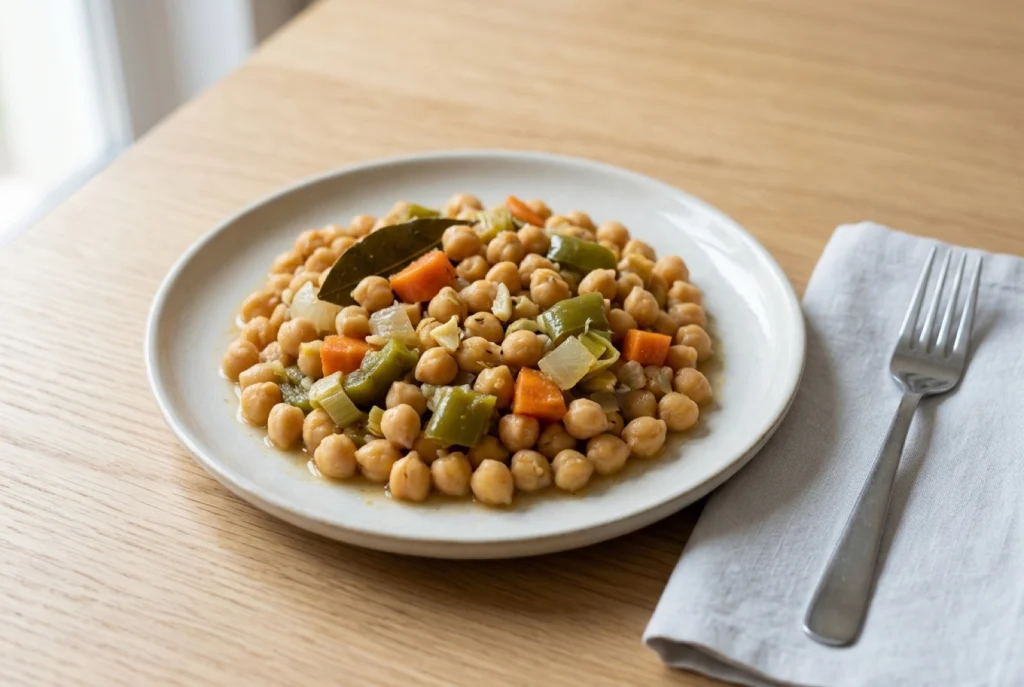
Not necessarily. Before removing pulses, check the amount and preparation you tolerate. The same dish contains fiber, plant protein, complex carbohydrates, iron and magnesium. What changes is how they reach the table.

- Long soak and fresh water. Follow the soaking and cooking instructions on the packet for each pulse; if you soak them, change the water before cooking. Some of the fermentable sugars go with it.
- Long, gentle cooking. Follow the time and preparation on the packet so they are cooked through.
- Without skin or pureed. If you find the skin bothers you, you can try a texture without it and observe your response. Red lentils already come without skin.
- In moderate portions and without a heavy second course afterwards. Often what is heavy is the whole meal.
What mistakes do we see in consultation?
What comes up most often is a very long list of foods removed, no testing done and the same belly as before. Almost always what is missing is order, that is, what is tested, for how long and how each food is reintroduced. Behind it there is usually one of these three self-directed eliminations.
The low-FODMAP diet with no end date. The low-FODMAP diet (restricting fermentable oligosaccharides, disaccharides, monosaccharides and polyols) is considered a second-line tool for irritable bowel [4].
In IBS, expert advice limits restriction to a maximum of four to six weeks; after that, foods are reintroduced according to tolerance [5].
The aim is to keep the diet as open as possible. Keeping it strict can reduce food variety; its long-term effects on the microbiota are unknown [4]. That is why it is advisable for a registered dietitian with digestive experience to support it [1] [4]. You can find more detail in the guide to the low-FODMAP diet.
Gluten before the test. If you suspect celiac disease, check with your doctor before removing gluten. Serology can help rule out celiac disease and, if positive, your doctor will assess confirmation by biopsy [1].
All dairy just in case. With lactose there is room before removing it. Before removing all dairy, discuss with your doctor whether it makes sense to assess a possible lactose intolerance. Tolerance and food options are reviewed individually.
«Intolerance» tests sold online are no use for this. Elimination diets based on IgG antibodies are not recommended [4]. Hair analysis and bioresonance have no validity either, and at Alimmenta we use neither. Diagnosis is medical and is made with validated tests.
Can you deflate your belly in three days?
Some people notice fewer symptoms when they change the fizzy drink, the amount at dinner, how the pulse is prepared or the chewing gum. There is no time frame that works for everyone. What does not exist is a food, an infusion or a shake that deflates a belly.
There is not enough evidence to recommend probiotics against bloating. The expert review by the American Gastroenterological Association advises against using them to treat bloating or distension [1]. No strains or brands are recommended without a specific medical indication.
If bloating has been there for months, it is no longer a matter of days. If distension recurs, your doctor can assess the Rome IV criteria [6].
These require, among other points, predominant symptoms at least once a week for three months, onset at least six months earlier and ruling out other bowel disorders. Counting the days is not enough to make a diagnosis.
And if it is SIBO?
Small intestinal bacterial overgrowth (SIBO) can cause the same thing. It causes bloating, gas and distension after eating. It is not diagnosed from a list of symptoms or with a test bought online.
Your doctor assesses whether there are grounds for a breath test; the ACG guideline suggests it in specific contexts, with very low-quality evidence [7]. In typical irritable bowel, the British guideline concludes that the breath test has no role in ruling out SIBO or carbohydrate intolerance [4].
Having symptoms is not enough to have a diagnosis.
Once a diagnosis is made, food is adapted to your symptoms and needs, alongside medical treatment. The ACG guideline does not set a general probiotic recommendation for SIBO [7]. This is what we do in the nutritionist for SIBO consultation.
When bloating gets worse in the afternoon
If you wake up with less volume and notice more distension after eating or at the end of the day, note the time it appears and whether there is pain, constipation or changes in bowel movements. The NIDDK suggests trying smaller meals and eating slowly when gas is bothersome [2].
That timing does not show that a food is the cause or allow SIBO to be diagnosed. Changes in the response of the diaphragm and abdominal wall can also occur without much increase in gas [1]. If the symptom is new, persistent or getting worse, check the warning signs in this guide.
Weekly menu for bloating: indicative example
This sample week for an adult without a digestive diagnosis does not eliminate food groups or promise to deflate. NIDDK suggests smaller meals and eating slowly, and cites examples that in some people may cause more gas: apple, pear, broccoli and other cruciferous vegetables, pulses, dairy and whole-grain cereals [2].
This week includes them as examples; they are not a threshold or a list to remove. Adjust the amounts with a professional if you have special needs. Pulses and broccoli appear in moderate example amounts, not as a tolerance threshold: if any of them upsets you, review the amount and context before removing it.
This example includes gluten, milk, egg, fish, peanut, tree nuts and soy. Check the labels and adapt the dishes if you have a diagnosed allergy. The cod on the menu is fresh, not salted; the amounts in the table need individual adjustment.
| Day | Breakfast | Lunch | Dinner |
|---|---|---|---|
| Monday | dry oat flakes 60 g, natural whole-milk Greek yoghurt 200 g, peeled banana 120 g, shelled walnuts 20 g | skinless roast chicken breast 150 g, baked potato 250 g, cooked carrot 150 g, cooked courgette 150 g, olive oil 15 g, peeled orange 160 g | cooked lentils, no added fat 100 g, cooked quinoa, no added fat 150 g, cooked spinach 150 g, olive oil 10 g, edible apple 150 g |
| Tuesday | wholewheat bread 100 g, boiled egg 120 g, peeled kiwi 150 g, whole milk 200 g, shelled walnuts 20 g | fresh oven-baked cod 170 g, cooked wholewheat pasta 220 g, cooked broccoli 100 g, olive oil 15 g, edible pear 160 g | cooked chickpeas, no added fat 100 g, cooked couscous 180 g, cooked carrot 150 g, cooked courgette 150 g, olive oil 15 g, strawberries 150 g |
| Wednesday | natural whole-milk Greek yoghurt 200 g, dry oat flakes 50 g, strawberries 150 g, unsalted almonds 20 g | skinless roast chicken breast 150 g, cooked wholewheat pasta 200 g, cooked green beans, no added fat 200 g, olive oil 15 g, peeled orange 160 g | canned sardines 130 g, baked potato 250 g, cooked spinach 180 g, olive oil 15 g, peeled banana 100 g |
| Thursday | wholewheat bread 100 g, natural cottage cheese 150 g, peeled avocado 80 g, edible grapes 160 g, unsalted almonds 20 g | cooked chickpeas, no added fat 100 g, cooked quinoa, no added fat 200 g, cooked broccoli 100 g, olive oil 15 g, peeled kiwi 150 g | oven-baked salmon 160 g, cooked wholewheat pasta 200 g, cooked courgette 200 g, olive oil 15 g, edible apple 150 g |
| Friday | dry oat flakes 50 g, whole milk 250 g, edible pear 160 g, unsalted almonds 20 g | cooked lentils, no added fat 100 g, baked potato 250 g, cooked carrot 200 g, olive oil 15 g, peeled orange 160 g | boiled egg 120 g, wholewheat bread 100 g, cooked spinach 200 g, olive oil 15 g, peeled banana 120 g |
| Saturday | natural whole-milk Greek yoghurt 200 g, shelled walnuts 20 g, strawberries 120 g, dry corn flakes with no added sugars 50 g | fresh oven-baked cod 170 g, cooked couscous 220 g, cooked green beans, no added fat 200 g, olive oil 15 g, edible apple 150 g | prepared beef steak 150 g, roasted sweet potato 250 g, cooked green beans, no added fat 200 g, olive oil 15 g, edible pear 160 g |
| Sunday | cooked quinoa, no added fat 200 g, peanut butter 30 g, peeled kiwi 150 g, whole milk 200 g | skinless roast chicken breast 150 g, cooked broccoli 100 g, olive oil 15 g, cooked couscous 220 g, edible grapes 160 g | cooked firm tofu 180 g, cooked quinoa, no added fat 200 g, cooked green beans, no added fat 180 g, olive oil 15 g, edible grapes 150 g |
Shopping list for one person and seven days
Fruit
- edible apple 450 g
- peeled banana 340 g
- edible grapes 470 g
- peeled kiwi 450 g
- peeled orange 480 g
- edible pear 480 g
- strawberries 420 g
Vegetables and tubers
- peeled avocado 80 g
- cooked broccoli 300 g
- cooked carrot 500 g
- cooked green beans, no added fat 780 g
- baked potato 750 g
- cooked spinach 530 g
- roasted sweet potato 250 g
- cooked courgette 500 g
Cereals and bread
- wholewheat bread 300 g
- dry corn flakes with no added sugars 50 g
- cooked couscous 620 g
- dry oat flakes 160 g
- cooked wholewheat pasta 620 g
- cooked quinoa, no added fat 750 g
Pulses and nuts
- unsalted almonds 60 g
- cooked chickpeas, no added fat 200 g
- cooked lentils, no added fat 200 g
- peanut butter 30 g
- shelled walnuts 60 g
Fish, meat, eggs and tofu
- prepared beef steak 150 g
- skinless roast chicken breast 450 g
- fresh oven-baked cod 340 g
- boiled egg 240 g
- oven-baked salmon 160 g
- canned sardines 130 g
- cooked firm tofu 180 g
Dairy
- natural cottage cheese 150 g
- whole milk 650 g
- natural whole-milk Greek yoghurt 600 g
Oil
- olive oil 205 g
Indicative proposal for an adult. It is not an individualized plan and does not replace a consultation or medical treatment.
Quantities are edible weights in the state indicated. The shopping list adds up the edible weights in the table, without waste. When buying raw, dry, bone-in or in-shell foods, the amount to buy will be larger: calculate it with the yield of each product.
Rice does not appear in this proposal. Cook with water and serve water as the drink; if you want to split a large dish into two meals, keep the same total amount.
This example does not replace an assessment or a diet prescribed for a diagnosis. If the distension persists or is accompanied by a warning sign, the list and urgency level are in the «When to see a doctor» section of this same guide.
Cool cooked dishes before putting them in the fridge, in closed containers. Freeze the portions you will eat later. If you take food out of the house, keep it cold.
In the digestive nutritionist consultation we review your meals, your symptoms and the restrictions you have tried. We work from the medical assessment, in Barcelona and online. The menu is an indicative proposal for the team to adjust; it does not include an individual calorie calculation.
We explain it on video
More videos
Your first step this week
Note down when you bloat for one week
Write down when the bloating starts, what you ate and any other changes. Bring the notes to your appointment: a coincidence does not show what causes it.
Your menu for the FODMAP elimination phase
- 7-day menu with the shopping list
- 8 low-FODMAP recipes
- The portions that make the difference and label traps
Where should we send it?
Free PDF, in your inbox in a moment.
Data controller: Alimmenta Tu Vida, S.L. Purpose: to send you the guide and, only if you tick the second box, tips by email on the topic. You can withdraw your consent and exercise your rights at [email protected]. Legal basis, recipients and retention periods are in our privacy policy.
When to see a doctor
When you need to see a doctor
Food can help you identify what bothers you and recover variety. Bloating is a symptom, not a diagnosis; your doctor assesses its possible causes.
Seek medical attention without waiting to change your diet if any of these signs appear:
- If abdominal pain comes on suddenly or is severe, go to the emergency room [8]. If you cannot pass stool or wind with abdominal pain, also go to the emergency room [8]. If you vomit blood or the vomit looks like coffee grounds, go to the emergency room [8]. Black, sticky, very foul-smelling stools also require emergency care [8].
- If there is a lot of blood from the anus, the bleeding does not stop or the toilet water turns red, go to the emergency room [9]. If your stools are dark red or you have diarrhea with blood, go to the emergency room today [9]. If you see red blood in your stools and it is heavy, recurs or comes with severe pain or fever, go to the emergency room today [9]. If it is a small, one-off amount, ask for an appointment with your doctor this week [9].
- If you are a woman, a trans man or a non-binary person with female reproductive organs and have persistent or frequent abdominal distension —especially more than 12 times a month—, ask for a medical assessment. NICE indicates tests in primary care, especially from age 50 [10].
- If you are 60 or over and have lost weight without explanation, see your doctor promptly: NICE indicates urgent investigation or priority referral [10]. At any age, if you keep losing weight without changing your diet or your activity, ask for an appointment with your doctor this week, even if you have no bloating [11].
- If bloating recurs or does not go away, see your doctor [12]. If you have fever or severe abdominal pain, go to the emergency room today [12]. If it comes with vomiting, diarrhea, constipation or a lump in the belly, ask for an urgent medical appointment or care at a non-hospital urgent care service [12]. If you cannot pass stool or wind with a swollen belly, also seek urgent assessment, even if the pain is not severe [12].
- If your stools stay looser or more frequent than usual, see a doctor without waiting for a set age or time frame. NICE recommends offering a fecal immunochemical test for a change in bowel habit in adults [10]; your doctor decides which tests apply in Spain.
Sudden or severe abdominal pain, fever, vomiting blood, heavy or recurring blood in the stools, or blood with severe pain or fever, black sticky stools or heavy bleeding need emergency care today [8] [9]. For the other signs, ask for the assessment indicated without waiting for a diet to resolve them.

Tell us when your belly swells up
At the first visit we go over your symptoms, what you eat, how you eat it and at what times. The first guidance comes out of it. A week later you have your plan in writing.
Keep reading

Gastritis diet: what to eat and what to avoid
Before every meal you wonder how you are going to feel afterwards, and you end up eating fewer…

Feeling heavy after eating: why it happens and what may help
You've finished eating and your stomach feels full for hours, even though you don't always eat the same…

Intestinal gas: causes, foods and ways to ease discomfort
You feel bloated after eating and start to suspect everything on your plate. Where should you start?
Bristol stool chart: a visual guide and when to seek help
You look at your stool and wonder whether its shape is usual for you or worth mentioning at…
- Consultation
Digestive dietitian in Barcelona and online
Improving your symptoms starts with understanding your digestion
Book a visit → - Consultation
SIBO dietitian in Barcelona and online
Your gastroenterologist diagnoses SIBO with a breath test. From there, we take care of helping you with food.
Book a visit → - Consultation
Dietitian for bloating and gas in Barcelona and online
A swollen belly, gas and heavy digestion. We look for what causes them in your day-to-day life and…
Book a visit →



Recipes for this goal
Sources
- Moshiree B, Drossman D, Shaukat A. AGA Clinical Practice Update on Evaluation and Management of Belching, Abdominal Bloating, and Distention: Expert Review. Gastroenterology. 2023;165(3):791-800. doi:10.1053/j.gastro.2023.04.039
- NIDDK. Eating, Diet, & Nutrition for Gas in the Digestive Tract. Revisado en 2021. https://www.niddk.nih.gov/health-information/digestive-diseases/gas-digestive-tract/eating-diet-nutrition
- EFSA Panel on Dietetic Products, Nutrition and Allergies (NDA). Scientific Opinion on Dietary Reference Values for carbohydrates and dietary fibre. EFSA Journal. 2010;8(3):1462. doi:10.2903/j.efsa.2010.1462
- Vasant DH, Paine PA, Black CJ, et al. British Society of Gastroenterology guidelines on the management of irritable bowel syndrome. Gut. 2021;70(7):1214-1240. doi:10.1136/gutjnl-2021-324598
- Chey WD, Hashash JG, Manning L, et al. AGA Clinical Practice Update on the Role of Diet in Irritable Bowel Syndrome: Expert Review. Gastroenterology. 2022;162(6):1737-1745.e5. doi:10.1053/j.gastro.2021.12.248
- Lacy BE, Mearin F, Chang L, et al. Bowel Disorders. Gastroenterology. 2016;150(6):1393-1407. doi:10.1053/j.gastro.2016.02.031
- Pimentel M, Saad RJ, Long MD, Rao SSC. ACG Clinical Guideline: Small Intestinal Bacterial Overgrowth. Am J Gastroenterol. 2020;115(2):165-178. doi:10.14309/ajg.0000000000000501
- NHS. Stomach ache. https://www.nhs.uk/symptoms/stomach-ache/
- NHS. Bleeding from the bottom (rectal bleeding). https://www.nhs.uk/symptoms/bleeding-from-the-bottom-rectal-bleeding/
- National Institute for Health and Care Excellence. Suspected cancer: recognition and referral (NG12). NICE; 2015, actualizada en 2026. https://www.nice.org.uk/guidance/ng12
- NHS. Unintentional weight loss. https://www.nhs.uk/symptoms/unintentional-weight-loss/
- NHS. Bloating. https://www.nhs.uk/symptoms/bloating/
Written and reviewed by


How we can help
Now, applied to you
Dietitian for bloating and gas in Barcelona and onlineA swollen belly, gas and heavy digestion. We look for what causes them in your day-to-day life and sort it out with you, in Barcelona and online.
4.9 on Google · 5.0 on Doctoralia · 2,072 reviews